1PY0 | pdb_00001py0

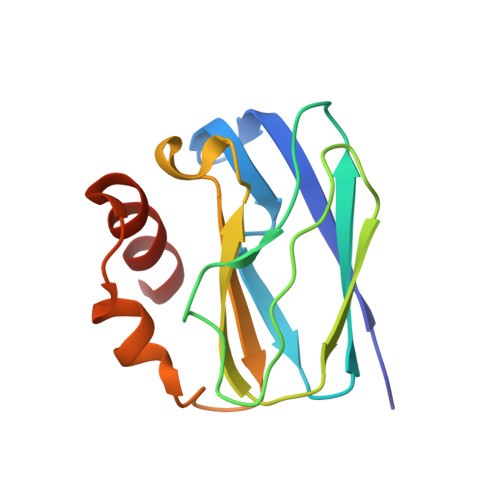
Crystal structure of E51C/E54C Psaz from A.faecalis with CLaNP probe


Experimental Data Snapshot

  • Method: X-RAY DIFFRACTION
  • Resolution: 2.00 Å
  • R-Value Free: 
    0.232 (Depositor) 
  • R-Value Work: 
    0.193 (Depositor) 
  • R-Value Observed: 
    0.196 (Depositor) 

Starting Model: experimental
View more details

wwPDB Validation 3D Report Full Report

Validation slider image for 1PY0

This is version 1.5 of the entry. See complete history

Literature

A caged lanthanide complex as a paramagnetic shift agent for protein NMR.

Prudencio, M.Rohovec, J.Peters, J.A.Tocheva, E.Boulanger, M.J.Murphy, M.E.Hupkes, H.J.Kosters, W.Impagliazzo, A.Ubbink, M.

(2004) Chemistry 10: 3252-3260

  • DOI: https://doi.org/10.1002/chem.200306019
  • Primary Citation Related Structures: 
    1PY0

  • PubMed Abstract: 

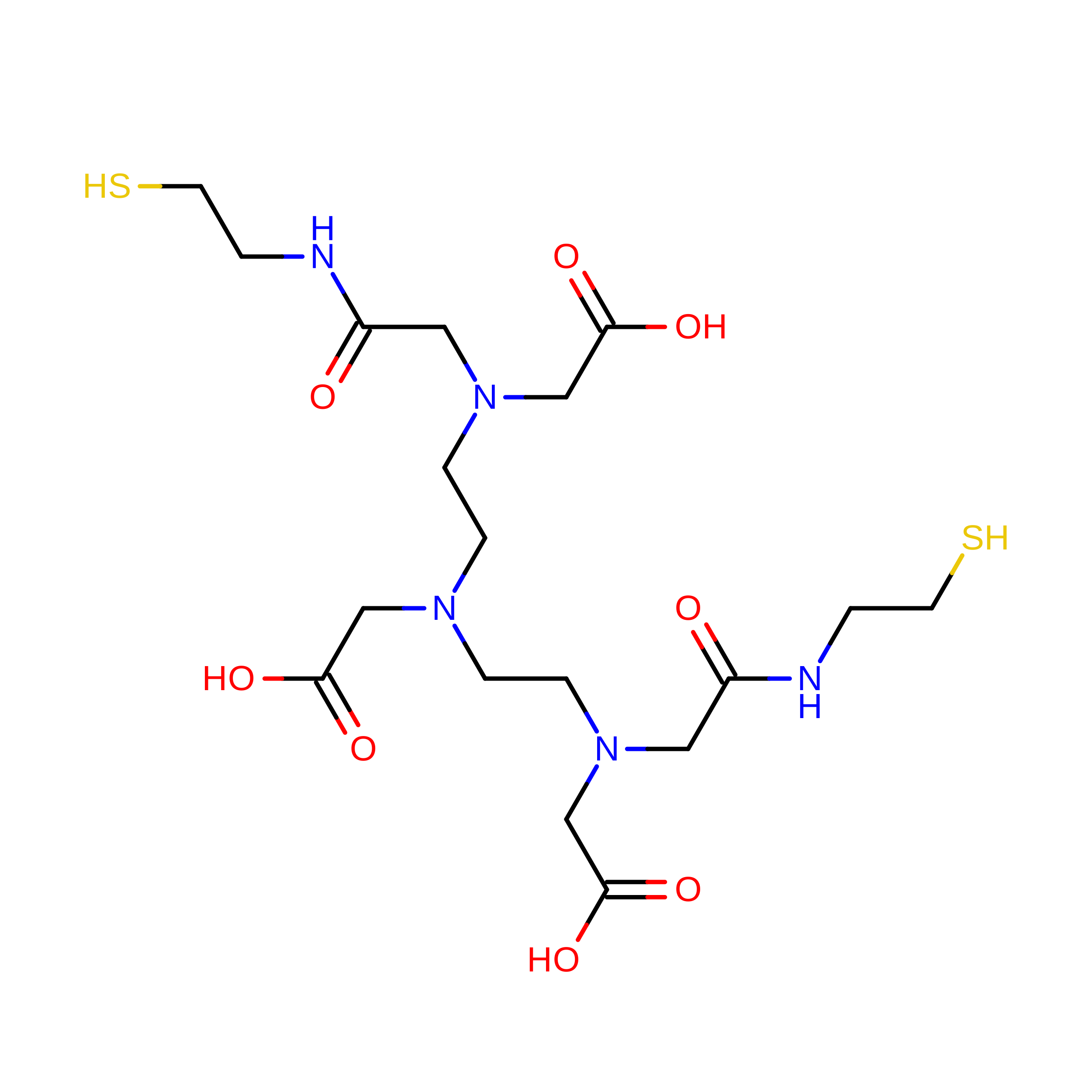
    A lanthanide complex, named CLaNP (caged lanthanide NMR probe) has been developed for the characterisation of proteins by paramagnetic NMR spectroscopy. The probe consists of a lanthanide chelated by a derivative of DTPA (diethylenetriaminepentaacetic acid) with two thiol reactive functional groups. The CLaNP molecule is attached to a protein by two engineered, surface-exposed, Cys residues in a bidentate manner. This drastically limits the dynamics of the metal relative to the protein and enables measurements of pseudocontact shifts. NMR spectroscopy experiments on a diamagnetic control and the crystal structure of the probe-protein complex demonstrate that the protein structure is not affected by probe attachment. The probe is able to induce pseudocontact shifts to at least 40 A from the metal and causes residual dipolar couplings due to alignment at a high magnetic field. The molecule exists in several isomeric forms with different paramagnetic tensors; this provides a fast way to obtain long-range distance restraints.


  • Organizational Affiliation
    • Leiden Institute of Chemistry, Gorlaeus Laboratories, Leiden University, P.O. Box 9502, 2300 RA Leiden, The Netherlands.

Macromolecule Content 

  • Total Structure Weight: 14.25 kDa 
  • Atom Count: 1,032 
  • Modeled Residue Count: 122 
  • Deposited Residue Count: 125 
  • Unique protein chains: 1

Macromolecules

Find similar proteins by:|  3D Structure
Entity ID: 1
MoleculeChains  Sequence LengthOrganismDetailsImage
Pseudoazurin125Alcaligenes faecalisMutation(s): 2 
UniProt
Find proteins for P04377 (Alcaligenes faecalis)
Explore P04377 
Go to UniProtKB:  P04377
Entity Groups
Sequence Clusters30% Identity50% Identity70% Identity90% Identity95% Identity100% Identity
UniProt GroupP04377
Sequence Annotations
Expand
Reference Sequence

Small Molecules

Ligands 4 Unique
IDChains Name / Formula / InChI Key2D Diagram3D Interactions
YMA

Query on YMA


Download:Ideal Coordinates CCD File
E [auth A]7,10,13-TRI(CARBOXYMETHYL)-5,15-DIOXO-4,7,10,13,16-PENTAAZA-1,19-DITHIANONADECANE
C18 H33 N5 O8 S2
MRDWXQKAAKNXSP-UHFFFAOYSA-N
SO4

Query on SO4


Download:Ideal Coordinates CCD File
D [auth A]SULFATE ION
O4 S
QAOWNCQODCNURD-UHFFFAOYSA-L
Y1

Query on Y1


Download:Ideal Coordinates CCD File
C [auth A]YTTRIUM ION
Y
KAJPZYFHSCFBCI-UHFFFAOYSA-N
ZN

Query on ZN


Download:Ideal Coordinates CCD File
B [auth A]ZINC ION
Zn
PTFCDOFLOPIGGS-UHFFFAOYSA-N

Experimental Data & Validation

Experimental Data

  • Method: X-RAY DIFFRACTION
  • Resolution: 2.00 Å
  • R-Value Free:  0.232 (Depositor) 
  • R-Value Work:  0.193 (Depositor) 
  • R-Value Observed: 0.196 (Depositor) 
Space Group: P 65
Unit Cell:
Length ( Å )Angle ( ˚ )
a = 42.7α = 90
b = 42.7β = 90
c = 116.9γ = 120
Software Package:
Software NamePurpose
REFMACrefinement
DENZOdata reduction
SCALEPACKdata scaling
AMoREphasing

Structure Validation

View Full Validation Report


Entry History 

Deposition Data

Revision History  (Full details and data files)

  • Version 1.0: 2004-12-07
    Type: Initial release
  • Version 1.1: 2008-04-29
    Changes: Version format compliance
  • Version 1.2: 2011-07-13
    Changes: Version format compliance
  • Version 1.3: 2021-10-27
    Changes: Database references, Derived calculations
  • Version 1.4: 2023-08-16
    Changes: Data collection, Refinement description
  • Version 1.5: 2024-10-30
    Changes: Structure summary