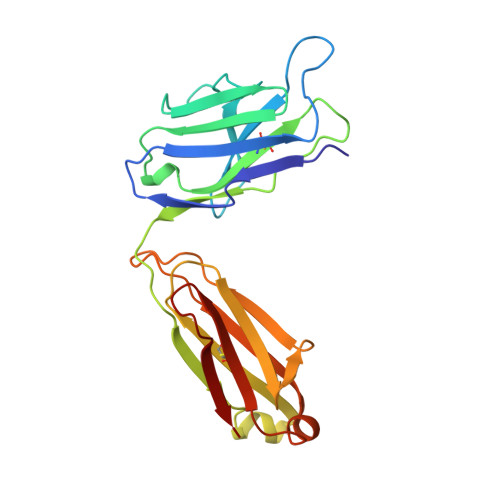
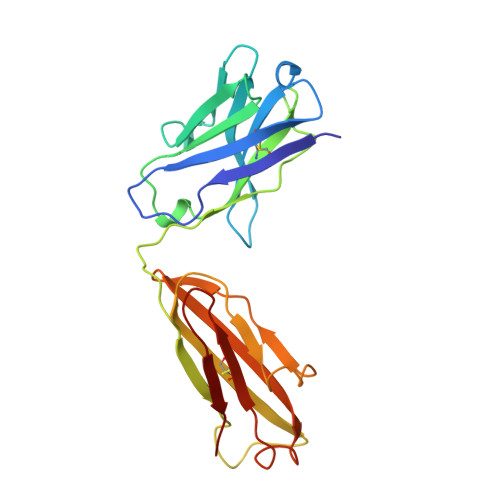
1PLG | pdb_00001plg

EVIDENCE FOR THE EXTENDED HELICAL NATURE OF POLYSACCHARIDE EPITOPES. THE 2.8 ANGSTROMS RESOLUTION STRUCTURE AND THERMODYNAMICS OF LIGAND BINDING OF AN ANTIGEN BINDING FRAGMENT SPECIFIC FOR ALPHA-(2->8)-POLYSIALIC ACID


Experimental Data Snapshot

  • Method: X-RAY DIFFRACTION
  • Resolution: 2.80 Å
  • R-Value Work: 
    0.164 (Depositor) 
  • R-Value Observed: 
    0.164 (Depositor) 

wwPDB Validation 3D Report Full Report

Validation slider image for 1PLG

This is version 1.5 of the entry. See complete history

Literature

Evidence for the extended helical nature of polysaccharide epitopes. The 2.8 A resolution structure and thermodynamics of ligand binding of an antigen binding fragment specific for alpha-(2-->8)-polysialic acid.

Evans, S.V.Sigurskjold, B.W.Jennings, H.J.Brisson, J.R.To, R.Tse, W.C.Altman, E.Frosch, M.Weisgerber, C.Kratzin, H.D.Klebert, S.Vaesen, M.Bitter-Suermann, D.Rose, D.R.Young, N.M.Bundle, D.R.

(1995) Biochemistry 34: 6737-6744

  • DOI: https://doi.org/10.1021/bi00020a019
  • Primary Citation Related Structures: 
    1PLG

  • PubMed Abstract: 

    The antigen binding fragment from an IgG2a kappa murine monoclonal antibody with specificity for alpha-(2-->8)-linked sialic acid polymers has been prepared and crystallized in the absence of hapten. Crystals were grown by vapor diffusion equilibrium with 16-18% polyethylene glycol 4000 solutions. The structure was solved by molecular replacement methods and refined to a conventional R factor of 0.164 for data to 2.8 A. The binding site is observed to display a shape and distribution of charges that is complementary to that of the predicted conformation of the oligosaccharide epitope. A thermodynamic description of ligand binding has been compiled for oligosaccharides ranging in length from 9 to 41 residues, and the data for the largest ligand has been used in a novel way to estimate the size of the antigen binding site. A model of antigen binding is presented that satisfies this thermodynamic data, as well as a previously reported requirement of conformational specificity of the oligosaccharide. X-ray crystallographic and thermodynamic evidence are consistent with a binding site that accommodates at least eight sialic acid residues.


  • Organizational Affiliation
    • Institute for Biological Sciences, National Research Council of Canada, Ottawa.

Macromolecule Content 

  • Total Structure Weight: 46.76 kDa 
  • Atom Count: 3,325 
  • Modeled Residue Count: 430 
  • Deposited Residue Count: 430 
  • Unique protein chains: 2

Macromolecules

Find similar proteins by:|  3D Structure
Entity ID: 1
MoleculeChains  Sequence LengthOrganismDetailsImage
IGG2A=KAPPA=A [auth L]215Mus musculusMutation(s): 0 
UniProt
Find proteins for A2NHM3 (Mus musculus)
Explore A2NHM3 
Go to UniProtKB:  A2NHM3
Entity Groups
Sequence Clusters30% Identity50% Identity70% Identity90% Identity95% Identity100% Identity
UniProt GroupA2NHM3
Sequence Annotations
Expand
Reference Sequence
Find similar proteins by:|  3D Structure
Entity ID: 2
MoleculeChains  Sequence LengthOrganismDetailsImage
IGG2A=KAPPA=B [auth H]215Mus musculusMutation(s): 0 
UniProt
Find proteins for P01865 (Mus musculus)
Explore P01865 
Go to UniProtKB:  P01865
Entity Groups
Sequence Clusters30% Identity50% Identity70% Identity90% Identity95% Identity100% Identity
UniProt GroupP01865
Sequence Annotations
Expand
Reference Sequence

Experimental Data & Validation

Experimental Data

  • Method: X-RAY DIFFRACTION
  • Resolution: 2.80 Å
  • R-Value Work:  0.164 (Depositor) 
  • R-Value Observed: 0.164 (Depositor) 
Space Group: I 2 2 2
Unit Cell:
Length ( Å )Angle ( ˚ )
a = 79.14α = 90
b = 91.21β = 90
c = 141.4γ = 90
Software Package:
Software NamePurpose
X-PLORmodel building
X-PLORrefinement
X-PLORphasing

Structure Validation

View Full Validation Report


Entry History 

Revision History  (Full details and data files)

  • Version 1.0: 1996-04-03
    Type: Initial release
  • Version 1.1: 2008-03-24
    Changes: Version format compliance
  • Version 1.2: 2011-07-13
    Changes: Version format compliance
  • Version 1.3: 2012-02-22
    Changes: Database references
  • Version 1.4: 2024-06-05
    Changes: Data collection, Database references, Other
  • Version 1.5: 2024-10-16
    Changes: Structure summary