1OK6 | pdb_00001ok6

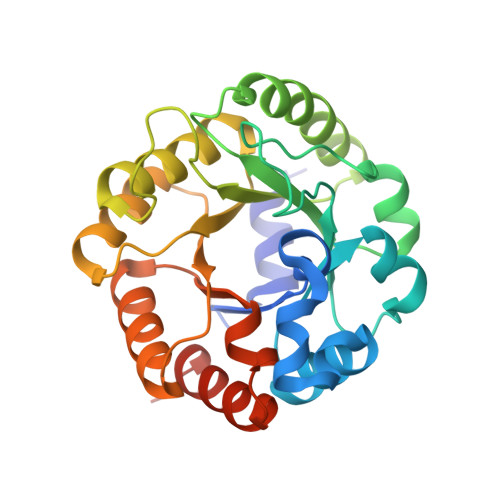
Orthorhombic crystal form of an Archaeal fructose 1,6-bisphosphate aldolase


Experimental Data Snapshot

  • Method: X-RAY DIFFRACTION
  • Resolution: 2.40 Å
  • R-Value Free: 
    0.263 (Depositor), 0.268 (DCC) 
  • R-Value Work: 
    0.232 (Depositor), 0.243 (DCC) 
  • R-Value Observed: 
    0.233 (Depositor) 

Starting Model: experimental
View more details

wwPDB Validation 3D Report Full Report

Validation slider image for 1OK6

This is version 1.6 of the entry. See complete history

Literature

Crystal structure of an archaeal class I aldolase and the evolution of (betaalpha)8 barrel proteins.

Lorentzen, E.Pohl, E.Zwart, P.Stark, A.Russell, R.B.Knura, T.Hensel, R.Siebers, B.

(2003) J Biological Chem 278: 47253-47260

  • DOI: https://doi.org/10.1074/jbc.M305922200
  • Primary Citation Related Structures: 
    1OJX, 1OK4, 1OK6

  • PubMed Abstract: 

    Fructose-1,6-bisphosphate aldolase (FBPA) catalyzes the reversible cleavage of fructose 1,6-bisphosphate to glyceraldehyde 3-phosphate and dihydroxyacetone phosphate in the glycolytic pathway. FBPAs from archaeal organisms have recently been identified and characterized as a divergent family of proteins. Here, we report the first crystal structure of an archaeal FBPA at 1.9-A resolution. The structure of this 280-kDa protein complex was determined using single wavelength anomalous dispersion followed by 10-fold non-crystallographic symmetry averaging and refined to an R-factor of 14.9% (Rfree 17.9%). The protein forms a dimer of pentamers, consisting of subunits adopting the ubiquitous (betaalpha)8 barrel fold. Additionally, a crystal structure of the archaeal FBPA covalently bound to dihydroxyacetone phosphate was solved at 2.1-A resolution. Comparison of the active site residues with those of classical FBPAs, which share no significant sequence identity but display the same overall fold, reveals a common ancestry between these two families of FBPAs. Structural comparisons, furthermore, establish an evolutionary link to the triosephosphate isomerases, a superfamily hitherto considered independent from the superfamily of aldolases.


  • Organizational Affiliation
    • European Molecular Biology Laboratory, Hamburg Outstation, Notkestrasse 85, D-22603 Hamburg, Germany.

Macromolecule Content 

  • Total Structure Weight: 287.5 kDa 
  • Atom Count: 20,126 
  • Modeled Residue Count: 2,522 
  • Deposited Residue Count: 2,630 
  • Unique protein chains: 1

Macromolecules

Find similar proteins by:|  3D Structure
Entity ID: 1
MoleculeChains  Sequence LengthOrganismDetailsImage
FRUCTOSE-BISPHOSPHATE ALDOLASE CLASS I
A, B, C, D, E
A, B, C, D, E, F, G, H, I, J
263Thermoproteus tenaxMutation(s): 0 
EC: 4.1.2.13
UniProt
Find proteins for P58315 (Thermoproteus tenax (strain ATCC 35583 / DSM 2078 / JCM 9277 / NBRC 100435 / Kra 1))
Explore P58315 
Go to UniProtKB:  P58315
Entity Groups
Sequence Clusters30% Identity50% Identity70% Identity90% Identity95% Identity100% Identity
UniProt GroupP58315
Sequence Annotations
Expand
Reference Sequence

Small Molecules

Ligands 1 Unique
IDChains Name / Formula / InChI Key2D Diagram3D Interactions
GOL

Query on GOL


Download:Ideal Coordinates CCD File
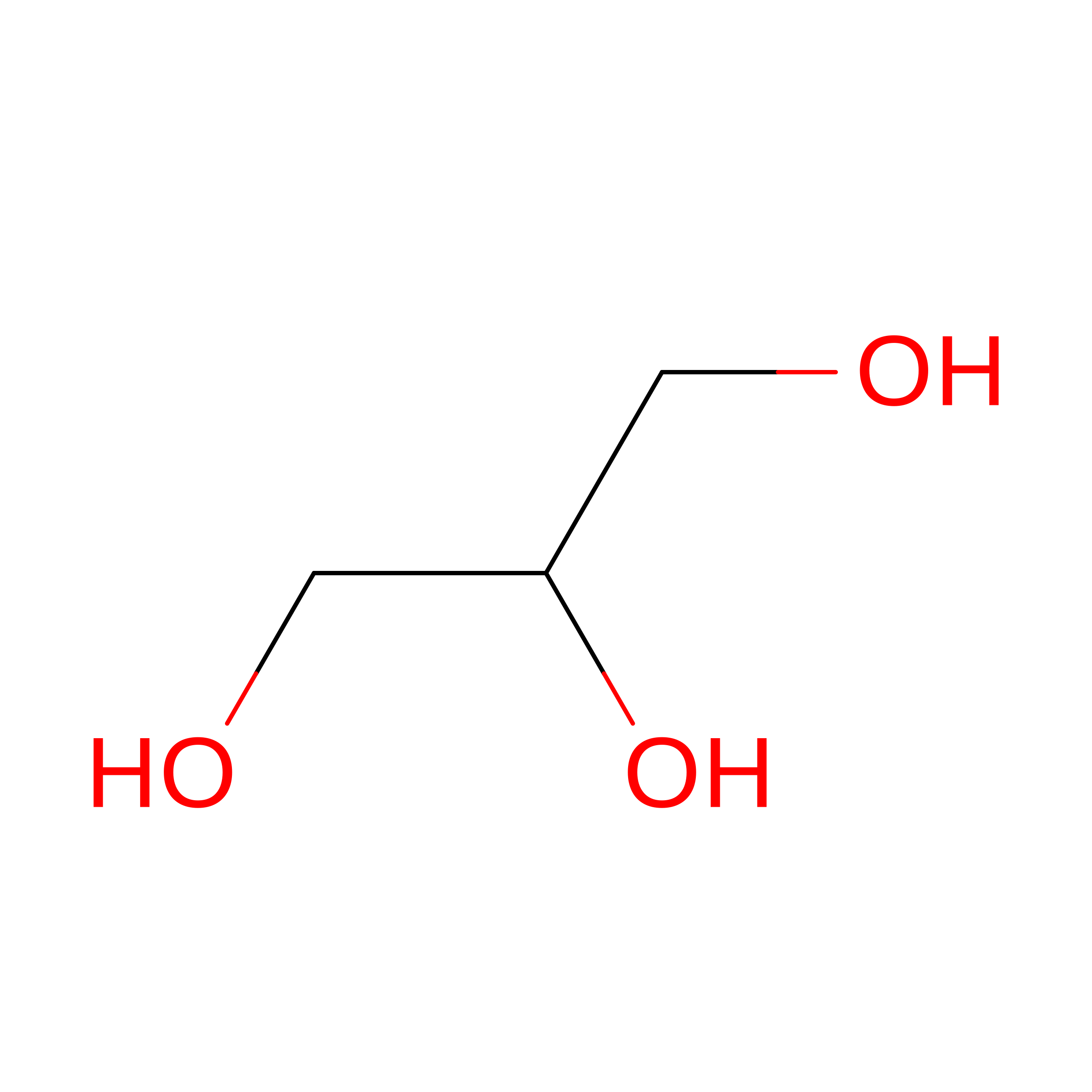
K [auth A]GLYCEROL
C3 H8 O3
PEDCQBHIVMGVHV-UHFFFAOYSA-N

Experimental Data & Validation

Experimental Data

  • Method: X-RAY DIFFRACTION
  • Resolution: 2.40 Å
  • R-Value Free:  0.263 (Depositor), 0.268 (DCC) 
  • R-Value Work:  0.232 (Depositor), 0.243 (DCC) 
  • R-Value Observed: 0.233 (Depositor) 
Space Group: P 21 21 21
Unit Cell:
Length ( Å )Angle ( ˚ )
a = 89.9α = 90
b = 176.5β = 90
c = 185.7γ = 90
Software Package:
Software NamePurpose
REFMACrefinement
DENZOdata reduction
SCALEPACKdata scaling
AMoREphasing

Structure Validation

View Full Validation Report


Entry History 

Deposition Data

Revision History  (Full details and data files)

  • Version 1.0: 2003-09-04
    Type: Initial release
  • Version 1.1: 2011-05-08
    Changes: Version format compliance
  • Version 1.2: 2011-07-13
    Changes: Version format compliance
  • Version 1.3: 2018-03-28
    Changes: Data collection, Database references, Refinement description, Source and taxonomy
  • Version 1.4: 2019-07-10
    Changes: Data collection
  • Version 1.5: 2019-07-24
    Changes: Data collection
  • Version 1.6: 2023-12-13
    Changes: Data collection, Database references, Derived calculations, Other, Refinement description