1O0V | pdb_00001o0v

The crystal structure of IgE Fc reveals an asymmetrically bent conformation


Experimental Data Snapshot

  • Method: X-RAY DIFFRACTION
  • Resolution: 2.60 Å
  • R-Value Free: 
    0.297 (Depositor), 0.235 (DCC) 
  • R-Value Work: 
    0.218 (Depositor), 0.221 (DCC) 

wwPDB Validation 3D Report Full Report

Validation slider image for 1O0V

This is version 2.3 of the entry. See complete history

Literature

The crystal structure of IgE Fc reveals an asymmetrically bent conformation

Wan, T.Beavil, R.L.Fabiane, S.M.Beavil, A.J.Sohi, M.K.Keown, M.Young, R.J.Henry, A.J.Owens, R.J.Gould, H.J.Sutton, B.J.

(2002) Nat Immunol 3: 681-686

  • DOI: https://doi.org/10.1038/ni811
  • Primary Citation Related Structures: 
    1O0V

  • PubMed Abstract: 

    The distinguishing structural feature of immunoglobulin E (IgE), the antibody responsible for allergic hypersensitivity, is the C epsilon 2 domain pair that replaces the hinge region of IgG. The crystal structure of the IgE Fc (constant fragment) at a 2.6-A resolution has revealed these domains. They display a distinctive, disulfide-linked Ig domain interface and are folded back asymmetrically onto the C epsilon 3 and C epsilon 4 domains, which causes an acute bend in the IgE molecule. The structure implies that a substantial conformational change involving C epsilon 2 must accompany binding to the mast cell receptor Fc epsilon RI. This may be the basis of the exceptionally slow dissociation rate of the IgE-Fc epsilon RI complex and, thus, of the ability of IgE to cause persistent allergic sensitization of mast cells.


  • Organizational Affiliation
    • The Randall Centre, King's College London, New Hunt's House, London SE1 1UL, UK.

Macromolecule Content 

  • Total Structure Weight: 75.72 kDa 
  • Atom Count: 5,436 
  • Modeled Residue Count: 639 
  • Deposited Residue Count: 654 
  • Unique protein chains: 1

Macromolecules

Find similar proteins by:|  3D Structure
Entity ID: 1
MoleculeChains  Sequence LengthOrganismDetailsImage
Immunoglobulin heavy chain epsilon-1
A, B
327Homo sapiensMutation(s): 3 
Gene Names: IgE(ND)
UniProt & NIH Common Fund Data Resources
Find proteins for P01854 (Homo sapiens)
Explore P01854 
Go to UniProtKB:  P01854
PHAROS:  P01854
GTEx:  ENSG00000211891 
Entity Groups
Sequence Clusters30% Identity50% Identity70% Identity90% Identity95% Identity100% Identity
UniProt GroupP01854
Glycosylation
Glycosylation Sites: 1Go to GlyGen: P01854-2
Sequence Annotations
Expand
Reference Sequence

Oligosaccharides

Help  
Entity ID: 2
MoleculeChains Length2D Diagram GlycosylationD Interactions
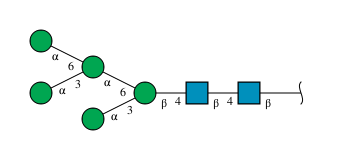
alpha-D-mannopyranose-(1-3)-[alpha-D-mannopyranose-(1-6)]alpha-D-mannopyranose-(1-6)-[alpha-D-mannopyranose-(1-3)]beta-D-mannopyranose-(1-4)-2-acetamido-2-deoxy-beta-D-glucopyranose-(1-4)-2-acetamido-2-deoxy-beta-D-glucopyranose
C
7N-Glycosylation
Glycosylation Resources
GlyTouCan: G55220VL
GlyCosmos: G55220VL
GlyGen: G55220VL
Entity ID: 3
MoleculeChains Length2D Diagram GlycosylationD Interactions
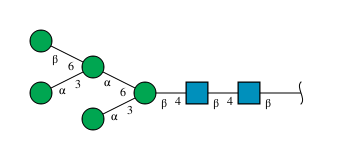
alpha-D-mannopyranose-(1-3)-[beta-D-mannopyranose-(1-6)]alpha-D-mannopyranose-(1-6)-[alpha-D-mannopyranose-(1-3)]beta-D-mannopyranose-(1-4)-2-acetamido-2-deoxy-beta-D-glucopyranose-(1-4)-2-acetamido-2-deoxy-beta-D-glucopyranose
D
7N-Glycosylation
Glycosylation Resources
GlyTouCan: G34059IB
GlyCosmos: G34059IB
GlyGen: G34059IB

Experimental Data & Validation

Experimental Data

  • Method: X-RAY DIFFRACTION
  • Resolution: 2.60 Å
  • R-Value Free:  0.297 (Depositor), 0.235 (DCC) 
  • R-Value Work:  0.218 (Depositor), 0.221 (DCC) 
Space Group: P 21 21 2
Unit Cell:
Length ( Å )Angle ( ˚ )
a = 129.31α = 90
b = 74.83β = 90
c = 78.65γ = 90
Software Package:
Software NamePurpose
DENZOdata reduction
SCALAdata scaling
SOLVEphasing
MLPHAREphasing
FFFEARmodel building
CNSrefinement
CCP4data scaling
FFFEARphasing

Structure Validation

View Full Validation Report


Entry History 

Deposition Data

Revision History  (Full details and data files)

  • Version 1.0: 2002-09-18
    Type: Initial release
  • Version 1.1: 2008-04-26
    Changes: Version format compliance
  • Version 1.2: 2011-07-13
    Changes: Non-polymer description, Version format compliance
  • Version 1.3: 2017-10-04
    Changes: Refinement description
  • Version 2.0: 2020-07-29
    Type: Remediation
    Reason: Carbohydrate remediation
    Changes: Atomic model, Data collection, Derived calculations, Structure summary
  • Version 2.1: 2021-10-27
    Changes: Database references, Structure summary
  • Version 2.2: 2023-12-27
    Changes: Data collection
  • Version 2.3: 2024-10-30
    Changes: Structure summary