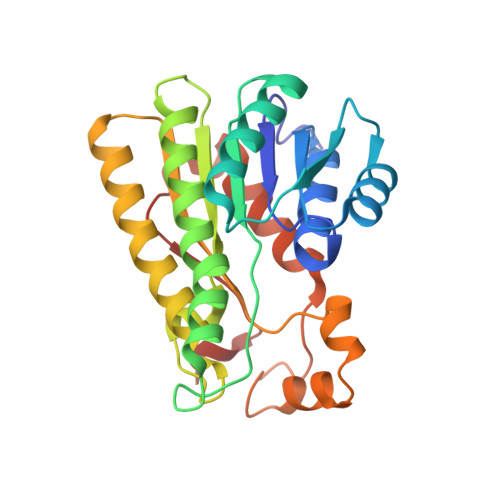
1NXQ | pdb_00001nxq

Crystal Structure of R-alcohol dehydrogenase (RADH) (apoenyzme) from Lactobacillus brevis


Experimental Data Snapshot

  • Method: X-RAY DIFFRACTION
  • Resolution: 1.79 Å
  • R-Value Free: 
    0.178 (Depositor), 0.186 (DCC) 
  • R-Value Work: 
    0.150 (Depositor), 0.163 (DCC) 
  • R-Value Observed: 
    0.151 (Depositor) 

Starting Model: experimental
View more details

wwPDB Validation 3D Report Full Report

Validation slider image for 1NXQ

This is version 1.3 of the entry. See complete history

Literature

The crystal structure of R-specific alcohol dehydrogenase from Lactobacillus brevis suggests the structural basis of its metal dependency

Niefind, K.Muller, J.Riebel, B.Hummel, W.Schomburg, D.

(2003) J Mol Biology 327: 317-328

  • DOI: https://doi.org/10.1016/s0022-2836(03)00081-0
  • Primary Citation Related Structures: 
    1NXQ

  • PubMed Abstract: 

    The crystal structure of the apo-form of an R-specific alcohol dehydrogenase from Lactobacillus brevis (LB-RADH) was solved and refined to 1.8A resolution. LB-RADH is a member of the short-chain dehydrogenase/reductase (SDR) enyzme superfamily. It is a homotetramer with 251 amino acid residues per subunit and uses NADP(H) as co-enzyme. NADPH and the substrate acetophenone were modelled into the active site. The enantiospecificity of the enzyme can be explained on the basis of the resulting hypothetical ternary complex. In contrast to most other SDR enzymes, the catalytic activity of LB-RADH depends strongly on the binding of Mg(2+). Mg(2+) removal by EDTA inactivates the enzyme completely. In the crystal structure, the Mg(2+)-binding site is well defined. The ion has a perfect octahedral coordination sphere and occupies a special position concerning crystallographic and molecular point symmetry, meaning that each RADH tetramer contains two magnesium ions. The magnesium ion is no direct catalytic cofactor. However, it is structurally coupled to the putative C-terminal hinge of the substrate-binding loop and, via an extended hydrogen bonding network, to some side-chains forming the substrate binding region. Therefore, the presented structure of apo-RADH provides plausible explanations for the metal dependence of the enzyme.


  • Organizational Affiliation
    • Universität zu Köln, Institut für Biochemie, Zülpicher Strasse 47, Germany.

Macromolecule Content 

  • Total Structure Weight: 26.68 kDa 
  • Atom Count: 2,067 
  • Modeled Residue Count: 251 
  • Deposited Residue Count: 251 
  • Unique protein chains: 1

Macromolecules

Find similar proteins by:|  3D Structure
Entity ID: 1
MoleculeChains  Sequence LengthOrganismDetailsImage
R-alcohol dehydrogenase251Levilactobacillus brevisMutation(s): 0 
EC: 1.1.1.2
UniProt
Find proteins for Q84EX5 (Levilactobacillus brevis)
Explore Q84EX5 
Go to UniProtKB:  Q84EX5
Entity Groups
Sequence Clusters30% Identity50% Identity70% Identity90% Identity95% Identity100% Identity
UniProt GroupQ84EX5
Sequence Annotations
Expand
Reference Sequence

Small Molecules

Ligands 1 Unique
IDChains Name / Formula / InChI Key2D Diagram3D Interactions
MG

Query on MG


Download:Ideal Coordinates CCD File
B [auth A]MAGNESIUM ION
Mg
JLVVSXFLKOJNIY-UHFFFAOYSA-N

Experimental Data & Validation

Experimental Data

  • Method: X-RAY DIFFRACTION
  • Resolution: 1.79 Å
  • R-Value Free:  0.178 (Depositor), 0.186 (DCC) 
  • R-Value Work:  0.150 (Depositor), 0.163 (DCC) 
  • R-Value Observed: 0.151 (Depositor) 
Space Group: I 2 2 2
Unit Cell:
Length ( Å )Angle ( ˚ )
a = 56.444α = 90
b = 85.065β = 90
c = 115.336γ = 90
Software Package:
Software NamePurpose
REFMACrefinement
DENZOdata reduction
SCALEPACKdata scaling
X-PLORphasing

Structure Validation

View Full Validation Report


Entry History 

Deposition Data

Revision History  (Full details and data files)

  • Version 1.0: 2003-04-15
    Type: Initial release
  • Version 1.1: 2008-04-29
    Changes: Version format compliance
  • Version 1.2: 2011-07-13
    Changes: Derived calculations, Version format compliance
  • Version 1.3: 2023-10-25
    Changes: Data collection, Database references, Derived calculations, Refinement description