1NDC | pdb_00001ndc

X-RAY STRUCTURE OF NUCLEOSIDE DIPHOSPHATE KINASE COMPLEXED WITH DTDP AND MG2+ AT 2 A RESOLUTION


Experimental Data Snapshot

  • Method: X-RAY DIFFRACTION
  • Resolution: 2.00 Å
  • R-Value Work: 
    0.183 (Depositor) 
  • R-Value Observed: 
    0.183 (Depositor) 

wwPDB Validation 3D Report Full Report

Validation slider image for 1NDC

This is version 2.0 of the entry. See complete history

Literature

X-ray structure of nucleoside diphosphate kinase complexed with thymidine diphosphate and Mg2+ at 2-A resolution.

Cherfils, J.Morera, S.Lascu, I.Veron, M.Janin, J.

(1994) Biochemistry 33: 9062-9069

  • DOI: https://doi.org/10.1021/bi00197a006
  • Primary Citation Related Structures: 
    1NDC

  • PubMed Abstract: 

    We report the crystal structure of nucleoside diphosphate kinase (NDP kinase) from Dictyostelium discoideum with thymidine diphosphate (dTDP) and Mg2+ bound at the active site. The structure has been refined to an R-factor of 18.3% at 2-A resolution. The base stacks on the aromatic ring of Phe 64 near the protein surface and is wedged between the side chains of Phe 64 and Val 116. The sugar and the pyrophosphate are deeper inside the protein and make numerous H-bonds with protein side chains. There is no backbone interaction with the nucleotide. A Mg2+ ion bridges the alpha- and beta-phosphates and interacts with the protein via water molecules. NDP kinase shows little specificity toward ribonucleotides and deoxyribonucleotides. This property, required by the enzyme biological function, can now be analyzed by comparing the crystal structures of free, ADP-ligated, and dTDP-ligated enzymes. The most significant differences are located in residues 60-64, which adapt their conformation to allow Phe 64 to stack on both types of bases. Nonspecific binding is achieved by the absence of polar interaction between the base and protein atoms. The ribose of ADP and the deoxyribose of dTDP occupy similar positions, their hydroxyl groups interacting with Lys 16 and Asn 119. The H-bond between Lys 16 and the O2' hydroxyl of ADP is replaced by a similar interaction with a water molecule in the dTDP complex. The beta-phosphate position is the same for ADP and dTDP, suggesting that the mechanism of phosphate transfer is the same for all substrates ofNDP kinase.(ABSTRACT TRUNCATED AT 250 WORDS)


  • Organizational Affiliation
    • Laboratoire de Biologie Structurale, UMR 9920 CNRS-Université Paris-Sud, Gif-sur-Yvette, France.

Macromolecule Content 

  • Total Structure Weight: 17.24 kDa 
  • Atom Count: 1,278 
  • Modeled Residue Count: 150 
  • Deposited Residue Count: 155 
  • Unique protein chains: 1

Macromolecules

Find similar proteins by:|  3D Structure
Entity ID: 1
MoleculeChains  Sequence LengthOrganismDetailsImage
NUCLEOSIDE DIPHOSPHATE KINASE155Dictyostelium discoideumMutation(s): 0 
EC: 2.7.4.6
UniProt
Find proteins for P22887 (Dictyostelium discoideum)
Explore P22887 
Go to UniProtKB:  P22887
Entity Groups
Sequence Clusters30% Identity50% Identity70% Identity90% Identity95% Identity100% Identity
UniProt GroupP22887
Sequence Annotations
Expand
Reference Sequence

Small Molecules

Ligands 2 Unique
IDChains Name / Formula / InChI Key2D Diagram3D Interactions
TYD

Query on TYD


Download:Ideal Coordinates CCD File
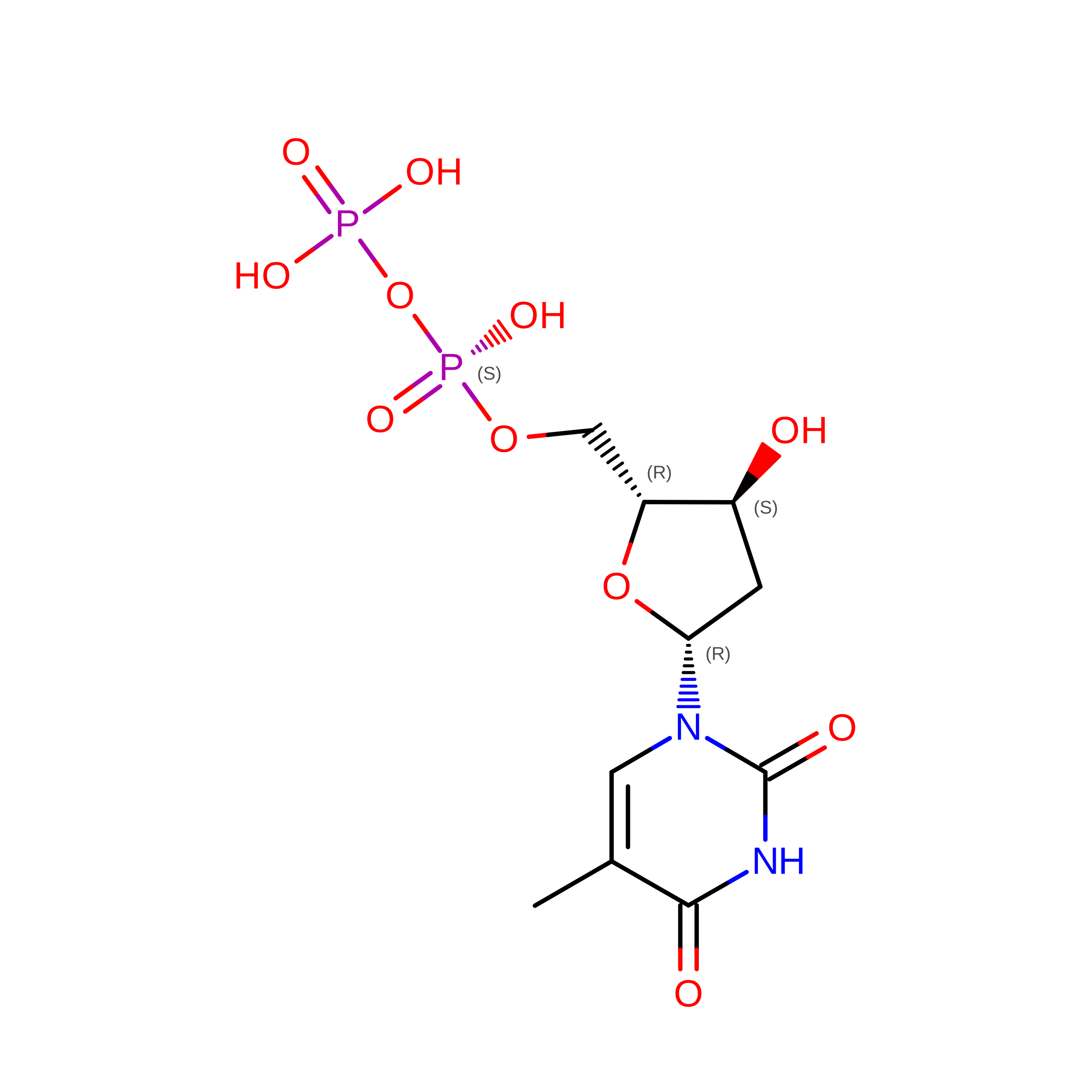
C [auth A]THYMIDINE-5'-DIPHOSPHATE
C10 H16 N2 O11 P2
UJLXYODCHAELLY-XLPZGREQSA-N
MG

Query on MG


Download:Ideal Coordinates CCD File
B [auth A]MAGNESIUM ION
Mg
JLVVSXFLKOJNIY-UHFFFAOYSA-N

Experimental Data & Validation

Experimental Data

  • Method: X-RAY DIFFRACTION
  • Resolution: 2.00 Å
  • R-Value Work:  0.183 (Depositor) 
  • R-Value Observed: 0.183 (Depositor) 
Space Group: H 3 2
Unit Cell:
Length ( Å )Angle ( ˚ )
a = 79.8α = 90
b = 79.8β = 90
c = 160.6γ = 120
Software Package:
Software NamePurpose
X-PLORmodel building
X-PLORrefinement
X-PLORphasing

Structure Validation

View Full Validation Report


Entry History 

Deposition Data

Revision History  (Full details and data files)

  • Version 1.0: 1994-06-22
    Type: Initial release
  • Version 1.1: 2008-03-24
    Changes: Version format compliance
  • Version 1.2: 2011-07-13
    Changes: Derived calculations, Version format compliance
  • Version 2.0: 2024-02-14
    Changes: Atomic model, Data collection, Database references, Derived calculations, Other