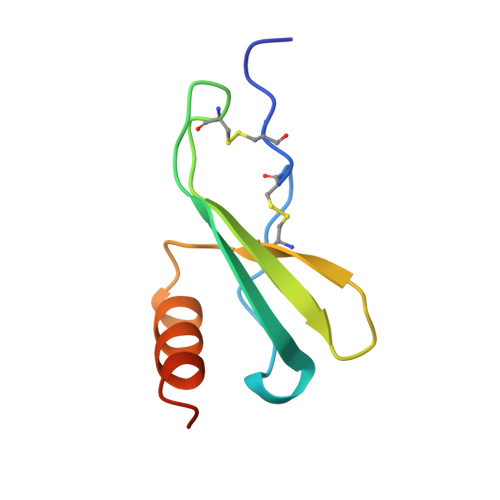
1NAP | pdb_00001nap

THE CRYSTAL STRUCTURE OF RECOMBINANT HUMAN NEUTROPHIL-ACTIVATING PEPTIDE-2 (M6L) AT 1.9-ANGSTROMS RESOLUTION


Experimental Data Snapshot

  • Method: X-RAY DIFFRACTION
  • Resolution: 1.90 Å
  • R-Value Free: 
    0.230 (Depositor) 
  • R-Value Work: 
    0.202 (Depositor), 0.183 (DCC) 
  • R-Value Observed: 
    0.202 (Depositor) 

wwPDB Validation 3D Report Full Report

Validation slider image for 1NAP

This is version 1.5 of the entry. See complete history

Literature

The crystal structure of recombinant human neutrophil-activating peptide-2 (M6L) at 1.9-A resolution.

Malkowski, M.G.Wu, J.Y.Lazar, J.B.Johnson, P.H.Edwards, B.F.

(1995) J Biological Chem 270: 7077-7087

  • DOI: https://doi.org/10.1074/jbc.270.13.7077
  • Primary Citation Related Structures: 
    1NAP

  • PubMed Abstract: 

    Neutrophil-activating peptide-2 (NAP-2) is a 70-residue carboxyl-terminal fragment of platelet basic protein, which is found in the alpha-granules of human platelets. NAP-2, which belongs to the CXC family of chemokines that includes interleukin-8 and platelet factor 4, binds to the interleukin-8 type II receptor and induces a rise in cytosolic calcium, chemotaxis of neutrophils, and exocytosis. Crystals of recombinant NAP-2 in which the single methionine at position 6 was replaced by leucine to facilitate expression belong to space group P1 (unit cell parameters a = 40.8, b = 43.8, and c = 44.7 A and alpha = 98.4 degrees, beta = 120.3 degrees, and gamma = 92.8 degrees), with 4 molecules of NAP-2 (Mr = 7600) in the asymmetric unit. The molecular replacement solution calculated with bovine platelet factor 4 as the starting model was refined using rigid body refinement, manual fitting in solvent-leveled electron density maps, simulated annealing, and restrained least squares to an R-factor of 0.188 for 2 sigma data between 7.0- and 1.9-A resolution. The final refined crystal structure includes 265 solvent molecules. The overall tertiary structure, which is similar to that of platelet factor 4 and interleukin-8, includes an extended amino-terminal loop, three strands of antiparallel beta-sheet arranged in a Greek key fold, and one alpha-helix at the carboxyl terminus. The Glu-Leu-Arg sequence that is critical for receptor binding is fully defined by electron density and exhibits multiple conformations.


  • Organizational Affiliation
    • Department of Biochemistry, Wayne State University, Detroit, Michigan 48201, USA.

Macromolecule Content 

  • Total Structure Weight: 30.5 kDa 
  • Atom Count: 2,254 
  • Modeled Residue Count: 261 
  • Deposited Residue Count: 280 
  • Unique protein chains: 1

Macromolecules

Find similar proteins by:|  3D Structure
Entity ID: 1
MoleculeChains  Sequence LengthOrganismDetailsImage
NEUTROPHIL ACTIVATING PEPTIDE-2
A, B, C, D
70Homo sapiensMutation(s): 0 
UniProt & NIH Common Fund Data Resources
Find proteins for P02775 (Homo sapiens)
Explore P02775 
Go to UniProtKB:  P02775
PHAROS:  P02775
GTEx:  ENSG00000163736 
Entity Groups
Sequence Clusters30% Identity50% Identity70% Identity90% Identity95% Identity100% Identity
UniProt GroupP02775
Sequence Annotations
Expand
Reference Sequence

Experimental Data & Validation

Experimental Data

  • Method: X-RAY DIFFRACTION
  • Resolution: 1.90 Å
  • R-Value Free:  0.230 (Depositor) 
  • R-Value Work:  0.202 (Depositor), 0.183 (DCC) 
  • R-Value Observed: 0.202 (Depositor) 
Space Group: P 1
Unit Cell:
Length ( Å )Angle ( ˚ )
a = 40.77α = 98.37
b = 43.81β = 120.28
c = 44.65γ = 92.78
Software Package:
Software NamePurpose
GPRLSArefinement
X-PLORrefinement
X-PLORmodel building
FRODOmodel building
X-PLORphasing

Structure Validation

View Full Validation Report


Entry History 

Deposition Data

Revision History  (Full details and data files)

  • Version 1.0: 1995-12-19
    Type: Initial release
  • Version 1.1: 2008-03-24
    Changes: Version format compliance
  • Version 1.2: 2011-07-13
    Changes: Version format compliance
  • Version 1.3: 2019-07-17
    Changes: Data collection, Refinement description
  • Version 1.4: 2019-08-14
    Changes: Data collection, Refinement description
  • Version 1.5: 2024-11-06
    Changes: Data collection, Database references, Structure summary