1M5I | pdb_00001m5i

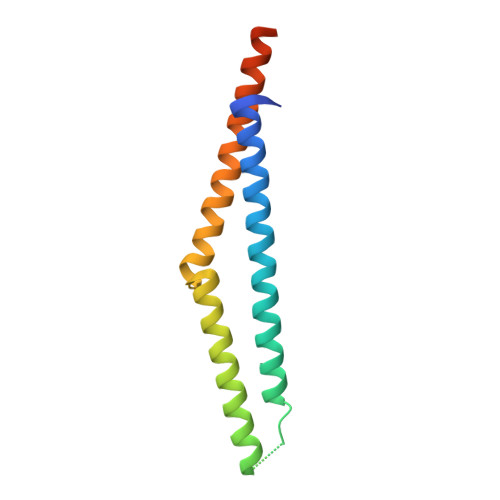
Crystal Structure of the coiled coil region 129-250 of the tumor suppressor gene product APC


Experimental Data Snapshot

  • Method: X-RAY DIFFRACTION
  • Resolution: 2.00 Å
  • R-Value Free: 
    0.309 (Depositor), 0.307 (DCC) 
  • R-Value Work: 
    0.257 (Depositor), 0.257 (DCC) 
  • R-Value Observed: 
    0.262 (Depositor) 

wwPDB Validation 3D Report Full Report

Validation slider image for 1M5I

This is version 1.3 of the entry. See complete history

Literature

The coiled coil region (amino acids 129-250) of the tumor suppressor protein adenomatous polyposis coli (APC). Its structure and its interaction with chromosome maintenance region 1 (Crm-1).

Tickenbrock, L.Cramer, J.Vetter, I.R.Muller, O.

(2002) J Biological Chem 277: 32332-32338

  • DOI: https://doi.org/10.1074/jbc.M203990200
  • Primary Citation Related Structures: 
    1M5I

  • PubMed Abstract: 

    The APC (adenomatous polyposis coli) tumor suppressor protein has many different intracellular functions including a nuclear export activity. Only little is known about the molecular architecture of the 2843-amino acid APC protein. Guided by secondary structure predictions we identified a fragment close to the N-terminal end, termed APC-(129-250), as a soluble and protease-resistant domain. We solved the crystal structure of APC-(129-250), which is monomeric and consists of three alpha-helices forming two separate antiparallel coiled coils. APC-(129-250) includes the nuclear export signal NES-(165-174) at the C-terminal end of the first helix. Surprisingly, the conserved hydrophobic amino acids of NES-(165-174) are buried in one of the coiled coils and are thus not accessible for interaction with other proteins. We demonstrate the direct interaction of APC-(129-250) with the nuclear export factor chromosome maintenance region 1 (Crm-1). This interaction is enhanced by the small GTPase Ran in its activated GTP-bound form and also by a double mutation in APC-(129-250), which deletes two amino acids forming two of the major interhelical interactions within the coiled coil. These observations hint to a regulatory mechanism of the APC nuclear export activity by NES masking.


  • Organizational Affiliation
    • Max-Planck-Institut für molekulare Physiologie, Abteilung Strukturelle Biologie, Otto-Hahn-Strasse 11, D-44227 Dortmund, Germany.

Macromolecule Content 

  • Total Structure Weight: 14.95 kDa 
  • Atom Count: 939 
  • Modeled Residue Count: 105 
  • Deposited Residue Count: 125 
  • Unique protein chains: 1

Macromolecules

Find similar proteins by:|  3D Structure
Entity ID: 1
MoleculeChains  Sequence LengthOrganismDetailsImage
APC protein125Homo sapiensMutation(s): 0 
Gene Names: APC
UniProt & NIH Common Fund Data Resources
Find proteins for P25054 (Homo sapiens)
Explore P25054 
Go to UniProtKB:  P25054
PHAROS:  P25054
GTEx:  ENSG00000134982 
Entity Groups
Sequence Clusters30% Identity50% Identity70% Identity90% Identity95% Identity100% Identity
UniProt GroupP25054
Sequence Annotations
Expand
Reference Sequence

Experimental Data & Validation

Experimental Data

  • Method: X-RAY DIFFRACTION
  • Resolution: 2.00 Å
  • R-Value Free:  0.309 (Depositor), 0.307 (DCC) 
  • R-Value Work:  0.257 (Depositor), 0.257 (DCC) 
  • R-Value Observed: 0.262 (Depositor) 
Space Group: P 32 2 1
Unit Cell:
Length ( Å )Angle ( ˚ )
a = 46.047α = 90
b = 46.047β = 90
c = 113.299γ = 120
Software Package:
Software NamePurpose
XDSdata scaling
XDSdata reduction
CNSrefinement
CNSphasing

Structure Validation

View Full Validation Report


Entry History 

Deposition Data

Revision History  (Full details and data files)

  • Version 1.0: 2002-11-20
    Type: Initial release
  • Version 1.1: 2008-04-28
    Changes: Version format compliance
  • Version 1.2: 2011-07-13
    Changes: Version format compliance
  • Version 1.3: 2024-03-13
    Changes: Data collection, Database references