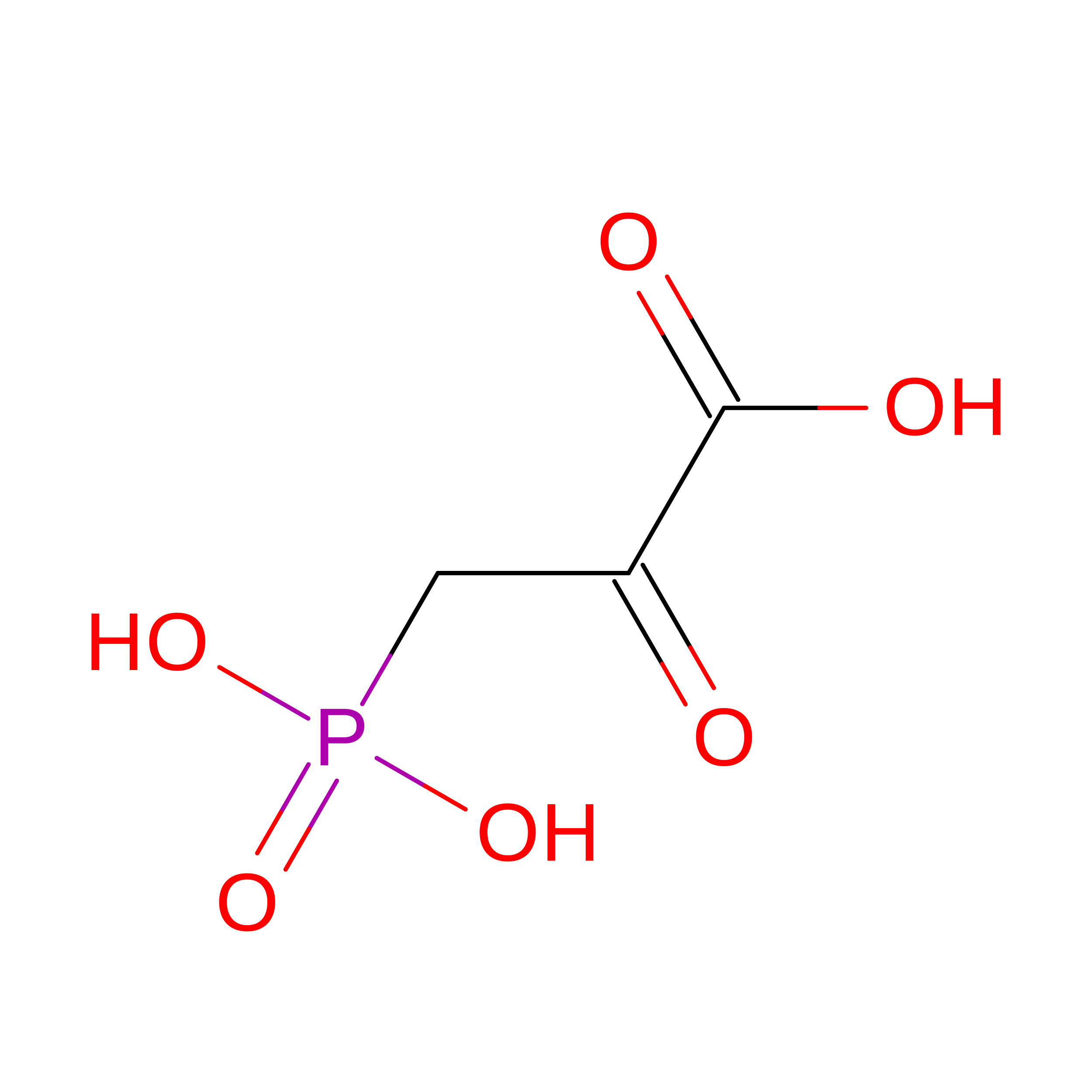
1KC7 | pdb_00001kc7

Pyruvate Phosphate Dikinase with Bound Mg-phosphonopyruvate


Experimental Data Snapshot

  • Method: X-RAY DIFFRACTION
  • Resolution: 2.20 Å
  • R-Value Free: 
    0.269 (Depositor), 0.283 (DCC) 
  • R-Value Work: 
    0.198 (Depositor), 0.241 (DCC) 

Starting Model: experimental
View more details

wwPDB Validation 3D Report Full Report

Validation slider image for 1KC7

Ligand Structure Quality Assessment 


This is version 1.3 of the entry. See complete history

Literature

Pyruvate site of pyruvate phosphate dikinase: crystal structure of the enzyme-phosphonopyruvate complex, and mutant analysis

Herzberg, O.Chen, C.C.Liu, S.Tempczyk, A.Howard, A.Wei, M.Ye, D.Dunaway-Mariano, D.

(2002) Biochemistry 41: 780-787

  • DOI: https://doi.org/10.1021/bi011799+
  • Primary Citation Related Structures: 
    1KBL, 1KC7

  • PubMed Abstract: 

    Crystals of pyruvate phosphate dikinase in complex with a substrate analogue inhibitor, phosphonopyruvate (K(i) = 3 microM), have been obtained in the presence of Mg(2+). The structure has been determined and refined at 2.2 A resolution, revealing that the Mg(2+)-bound phosphonopyruvate binds in the alpha/beta-barrel's central channel, at the C-termini of the beta-strands. The mode of binding resembles closely the previously proposed PEP substrate binding mode, inferred by the homology of the structure (but not sequence homology) to pyruvate kinase. Kinetic analysis of site-directed mutants, probing residues involved in inhibitor binding, showed that all mutations resulted in inactivation, confirming the key role that these residues play in catalysis. Comparison between the structure of the PPDK-phosphonopyruvate complex and the structures of two complexes of pyruvate kinase, one with Mg(2+)-bound phospholactate and the other with Mg(2+)-oxalate and ATP, revealed that the two enzymes share some key features that facilitate common modes of substrate binding. There are also important structural differences; most notably, the machinery for acid/base catalysis is different.


  • Organizational Affiliation
    • Center for Advanced Research in Biotechnology, University of Maryland Biotechnology Institute, 9600 Gudelsky Drive, Rockville, Maryland 20850, USA. osnat@carb.nist.gov

Macromolecule Content 

  • Total Structure Weight: 97.22 kDa 
  • Atom Count: 6,783 
  • Modeled Residue Count: 872 
  • Deposited Residue Count: 873 
  • Unique protein chains: 1

Macromolecules

Find similar proteins by:|  3D Structure
Entity ID: 1
MoleculeChains  Sequence LengthOrganismDetailsImage
pyruvate phosphate dikinase873[Clostridium] symbiosumMutation(s): 0 
Gene Names: PPDK
EC: 2.7.9.1
UniProt
Find proteins for P22983 (Clostridium symbiosum)
Explore P22983 
Go to UniProtKB:  P22983
Entity Groups
Sequence Clusters30% Identity50% Identity70% Identity90% Identity95% Identity100% Identity
UniProt GroupP22983
Sequence Annotations
Expand
Reference Sequence

Experimental Data & Validation

Experimental Data

  • Method: X-RAY DIFFRACTION
  • Resolution: 2.20 Å
  • R-Value Free:  0.269 (Depositor), 0.283 (DCC) 
  • R-Value Work:  0.198 (Depositor), 0.241 (DCC) 
Space Group: P 1 2 1
Unit Cell:
Length ( Å )Angle ( ˚ )
a = 89.21α = 90
b = 58.42β = 94.99
c = 102.55γ = 90
Software Package:
Software NamePurpose
CNSrefinement
X-GENdata reduction
X-GENdata scaling

Structure Validation

View Full Validation Report


Ligand Structure Quality Assessment 


Entry History 

Deposition Data

Revision History  (Full details and data files)

  • Version 1.0: 2002-01-30
    Type: Initial release
  • Version 1.1: 2008-04-27
    Changes: Version format compliance
  • Version 1.2: 2011-07-13
    Changes: Derived calculations, Version format compliance
  • Version 1.3: 2023-08-16
    Changes: Data collection, Database references, Derived calculations, Refinement description