Download Mendeley
NMR solution structure, backbone mobility, and homology modeling of c-type cytochromes from gram-positive bacteria.
Banci, L., Bertini, I., Ciurli, S., Dikiy, A., Dittmer, J., Rosato, A., Sciara, G., Thompsett, A.R.(2002) Chembiochem 3: 299-310
- PubMed: 11933230 Search on PubMed
- DOI: https://doi.org/10.1002/1439-7633(20020402)3:4<299::AID-CBIC299>3.0.CO;2-0
- Primary Citation Related Structures:
1K3G, 1K3H - PubMed Abstract:
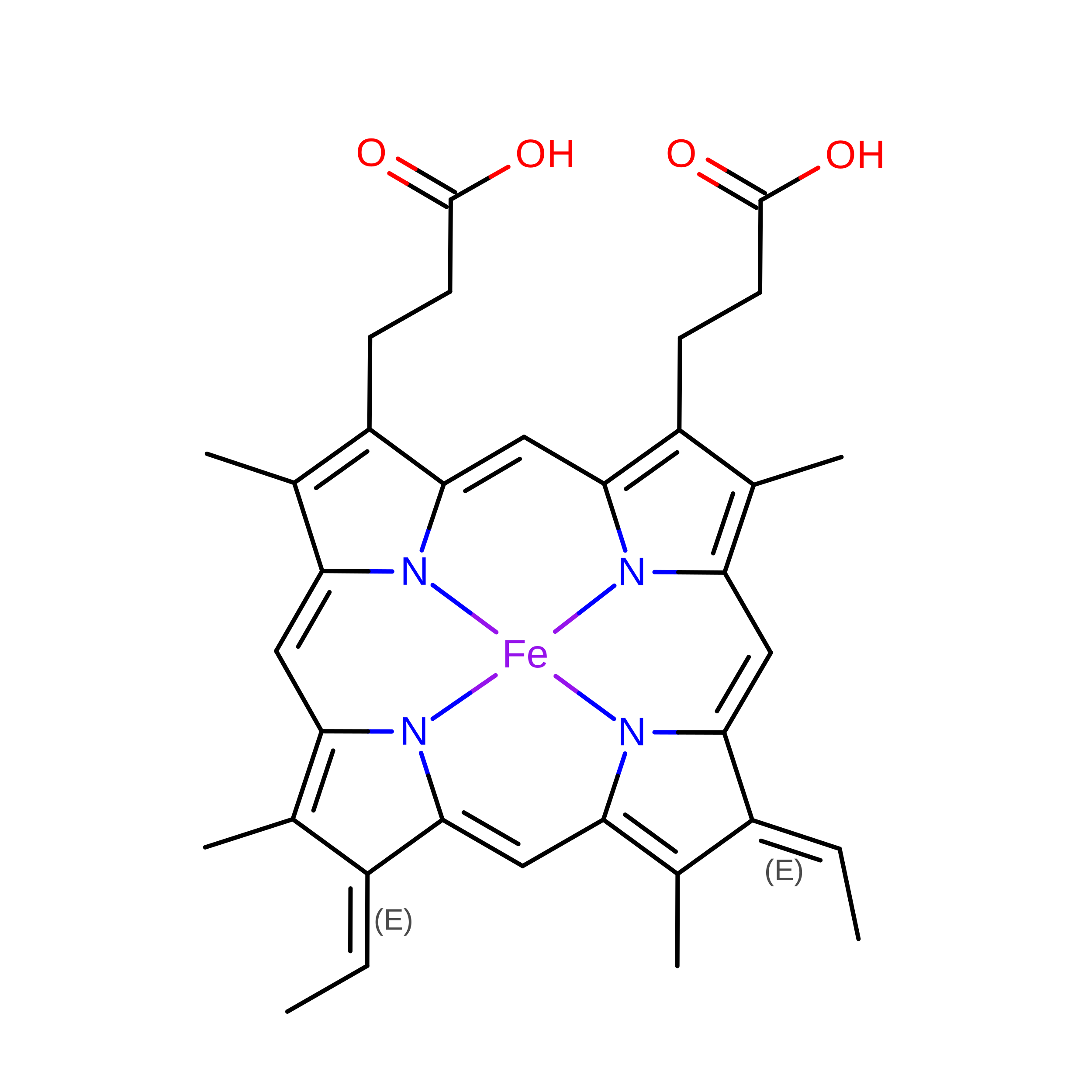
The solution structure of oxidized cytochrome c(553) (71 amino acid residues) from the Gram-positive bacterium Bacillus pasteurii is here reported and compared with the available crystal structure. The solution structure is obtained from 1609 meaningful NOE data (22.7 per residue), 76 dihedral angles, and 59 pseudocontact shifts. The root mean square deviations from the average structure are 0.25+/-0.07 and 0.59+/-0.13 A for the backbone and all heavy atoms, respectively, and the quality assessment of the structure is satisfactory. The solution structure closely reproduces the fold observed in the crystal structure. The backbone mobility was then investigated through amide (15)N relaxation rate and (15)N-(1)H NOE measurements. The protein is rigid in both the sub-nanosecond and millisecond time scales, probably due to the relatively large heme:number of amino acids ratio. Modeling of eight c-type cytochromes from other Gram-positive bacteria with a high sequence identity (>30 %) to the present cytochrome c(553) was performed. Analysis of consensus features accounts for the relatively low reduction potential as being due to extensive heme hydration and indicates residues 34-35, 44-46, 69-72, and 75 as a conserved hydrophobic patch for the interaction with a protein partner. At variance with mitochondrial c-type cytochrome, this protein does not experience pH-dependent coordination equilibria. The reasons for this difference are analyzed.
- Centro di Risonanze Magnetiche, University of Florence, Via Luigi Sacconi 6, 50019 Sesto Fiorentino, Italy.
Organizational Affiliation: