1J8G | pdb_00001j8g

X-ray Analysis of a RNA Tetraplex r(uggggu)4 at Ultra-High Resolution


Experimental Data Snapshot

  • Method: X-RAY DIFFRACTION
  • Resolution: 0.61 Å
  • R-Value Free: 
    0.112 (Depositor) 
  • R-Value Work: 
    0.103 (Depositor) 

wwPDB Validation 3D Report Full Report

Validation slider image for 1J8G

This is version 1.4 of the entry. See complete history

Literature

X-ray analysis of an RNA tetraplex (UGGGGU)(4) with divalent Sr(2+) ions at subatomic resolution (0.61 A).

Deng, J.Xiong, Y.Sundaralingam, M.

(2001) Proc Natl Acad Sci U S A 98: 13665-13670

  • DOI: https://doi.org/10.1073/pnas.241374798
  • Primary Citation Related Structures: 
    1J8G

  • PubMed Abstract: 

    Four-stranded guanine tetraplexes in RNA have been identified to be involved in crucial biological functions, such as dimerization of retroviral RNA, translational repression, and mRNA turnover. However, the structural basis for these biological processes is still largely unknown. Here we report the RNA tetraplex structure (UGGGGU)(4) at ultra-high resolution (0.61 A). The space group is P42(1)2, and cell constants are a = b = 36.16 A and c = 74.09 A. The structure was solved by the multiple-wavelength anomalous dispersion method using a set of three-wavelength data of the isomorphous bromo derivative (br)UGGGGU and refined to 0.61-A resolution. Each of the four strands in the asymmetric unit forms a parallel tetraplex with symmetry-related molecules. The tetraplex molecules stack on one another in opposite polarity (head-to-head or tail-to-tail) to form a pseudocontinuous column. All of the 5'-end uridines rotate around the backbone of G2, swing out, and form unique octaplexes with the neighboring G tetraplexes, whereas the 3'-end uridines are stacked-in and form uridine tetrads. All of the bases are anti, and the riboses are in the mixed C2'- and C3'-puckering mode. Strontium ions are observed in every other guanine tetrad plane, sitting on the fourfold axis and associated to the eight O6 atoms of neighboring guanine bases in a bipyramidal-antiprism geometry. The hydrogens are clearly observed in the structure.


  • Organizational Affiliation
    • Biological Macromolecular Structure Center, Department of Chemistry, Ohio State University, 012 Rightmire Hall, 1060 Carmack Road, Columbus, OH 43210-1002, USA.

Macromolecule Content 

  • Total Structure Weight: 8.86 kDa 
  • Atom Count: 674 
  • Modeled Residue Count: 24 
  • Deposited Residue Count: 24 
  • Unique nucleic acid chains: 1

Macromolecules

Find similar nucleic acids by:  Sequence
Entity ID: 1
MoleculeChains LengthOrganismImage
5'-R(*UP*GP*GP*GP*GP*U)-3'
A, B, C, D
6N/A
Sequence Annotations
Expand
Reference Sequence

Small Molecules

Ligands 4 Unique
IDChains Name / Formula / InChI Key2D Diagram3D Interactions
SPM

Query on SPM


Download:Ideal Coordinates CCD File
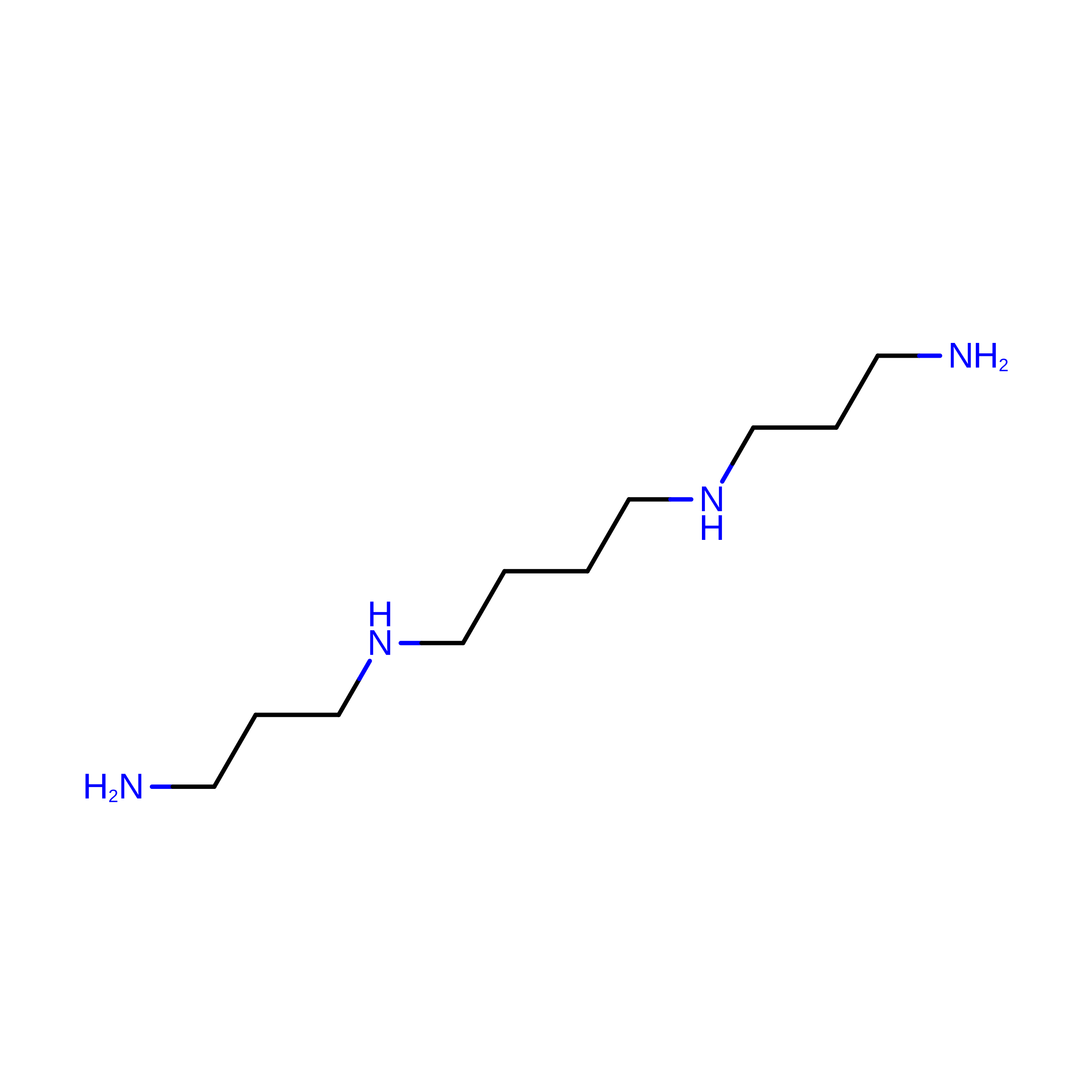
E [auth A]SPERMINE
C10 H26 N4
PFNFFQXMRSDOHW-UHFFFAOYSA-N
SR

Query on SR


Download:Ideal Coordinates CCD File
F [auth A]
G [auth A]
J [auth B]
K [auth B]
N [auth C]
F [auth A],
G [auth A],
J [auth B],
K [auth B],
N [auth C],
O [auth C],
Q [auth D],
R [auth D]
STRONTIUM ION
Sr
PWYYWQHXAPXYMF-UHFFFAOYSA-N
CA

Query on CA


Download:Ideal Coordinates CCD File
H [auth A],
L [auth B],
P [auth C]
CALCIUM ION
Ca
BHPQYMZQTOCNFJ-UHFFFAOYSA-N
NA

Query on NA


Download:Ideal Coordinates CCD File
I [auth A],
M [auth B]
SODIUM ION
Na
FKNQFGJONOIPTF-UHFFFAOYSA-N

Experimental Data & Validation

Experimental Data

  • Method: X-RAY DIFFRACTION
  • Resolution: 0.61 Å
  • R-Value Free:  0.112 (Depositor) 
  • R-Value Work:  0.103 (Depositor) 
Space Group: P 4 21 2
Unit Cell:
Length ( Å )Angle ( ˚ )
a = 36.154α = 90
b = 36.154β = 90
c = 74.134γ = 90
Software Package:
Software NamePurpose
MLPHAREphasing
SHELXL-97refinement
SCALEPACKdata scaling

Structure Validation

View Full Validation Report


Entry History 

Deposition Data

Revision History  (Full details and data files)

  • Version 1.0: 2001-11-23
    Type: Initial release
  • Version 1.1: 2008-04-27
    Changes: Version format compliance
  • Version 1.2: 2011-07-13
    Changes: Version format compliance
  • Version 1.3: 2011-11-16
    Changes: Atomic model
  • Version 1.4: 2024-02-07
    Changes: Data collection, Database references, Derived calculations