1IDQ | pdb_00001idq

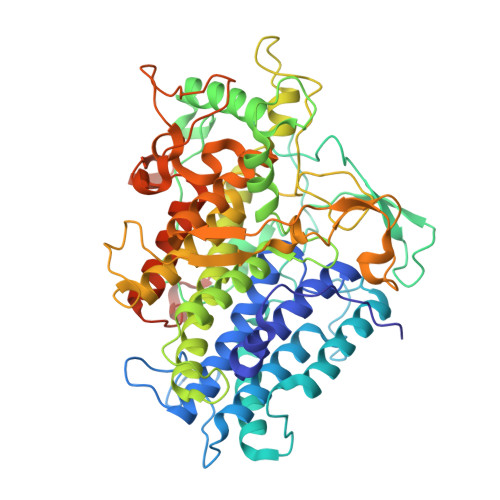
CRYSTAL STRUCTURE OF NATIVE VANADIUM-CONTAINING CHLOROPEROXIDASE FROM CURVULARIA INAEQUALIS


Experimental Data Snapshot

  • Method: X-RAY DIFFRACTION
  • Resolution: 2.03 Å
  • R-Value Work: 
    0.170 (Depositor), 0.159 (DCC) 

Starting Model: experimental
View more details

wwPDB Validation 3D Report Full Report

Validation slider image for 1IDQ

This is version 1.4 of the entry. See complete history

Literature

Implications for the catalytic mechanism of the vanadium-containing enzyme chloroperoxidase from the fungus Curvularia inaequalis by X-ray structures of the native and peroxide form.

Messerschmidt, A.Prade, L.Wever, R.

(1997) Biol Chem 378: 309-315

  • DOI: https://doi.org/10.1515/bchm.1997.378.3-4.309
  • Primary Citation Related Structures: 
    1IDQ, 1IDU

  • PubMed Abstract: 

    Implications for the catalytic mechanism of the vanadium-containing chloroperoxidase from the fungus Curvularia inaequalis have been obtained from the crystal structures of the native and peroxide forms of the enzyme. The X-ray structures have been solved by difference Fourier techniques using the atomic model of the azide chloroperoxidase complex. The 2.03 A crystal structure (R = 19.7%) of the native enzyme reveals the geometry of the intact catalytic vanadium center. The vanadium is coordinated by four non-protein oxygen atoms and one nitrogen (NE2) atom from histidine 496 in a trigonal bipyramidal fashion. Three oxygens are in the equatorial plane and the fourth oxygen and the nitrogen are at the apexes of the bipyramid. In the 2.24 A crystal structure (R = 17.7%) of the peroxide derivate the peroxide is bound to the vanadium in an eta2-fashion after the release of the apical oxygen ligand. The vanadium is coordinated also by 4 non-protein oxygen atoms and one nitrogen (NE2) from histidine 496. The coordination geometry around the vanadium is that of a distorted tetragonal pyramid with the two peroxide oxygens, one oxygen and the nitrogen in the basal plane and one oxygen in the apical position. A mechanism for the catalytic cycle has been proposed based on these X-ray structures and kinetic data.


  • Organizational Affiliation
    • Max-Planck-Institut für Biochemie, Martinsried bei München, Germany.

Macromolecule Content 

  • Total Structure Weight: 67.74 kDa 
  • Atom Count: 4,938 
  • Modeled Residue Count: 574 
  • Deposited Residue Count: 609 
  • Unique protein chains: 1

Macromolecules

Find similar proteins by:|  3D Structure
Entity ID: 1
MoleculeChains  Sequence LengthOrganismDetailsImage
VANADIUM CHLOROPEROXIDASE609Curvularia inaequalisMutation(s): 0 
EC: 1.11.1.10
UniProt
Find proteins for P49053 (Curvularia inaequalis)
Explore P49053 
Go to UniProtKB:  P49053
Entity Groups
Sequence Clusters30% Identity50% Identity70% Identity90% Identity95% Identity100% Identity
UniProt GroupP49053
Sequence Annotations
Expand
Reference Sequence

Small Molecules

Ligands 1 Unique
IDChains Name / Formula / InChI Key2D Diagram3D Interactions
VO4

Query on VO4


Download:Ideal Coordinates CCD File
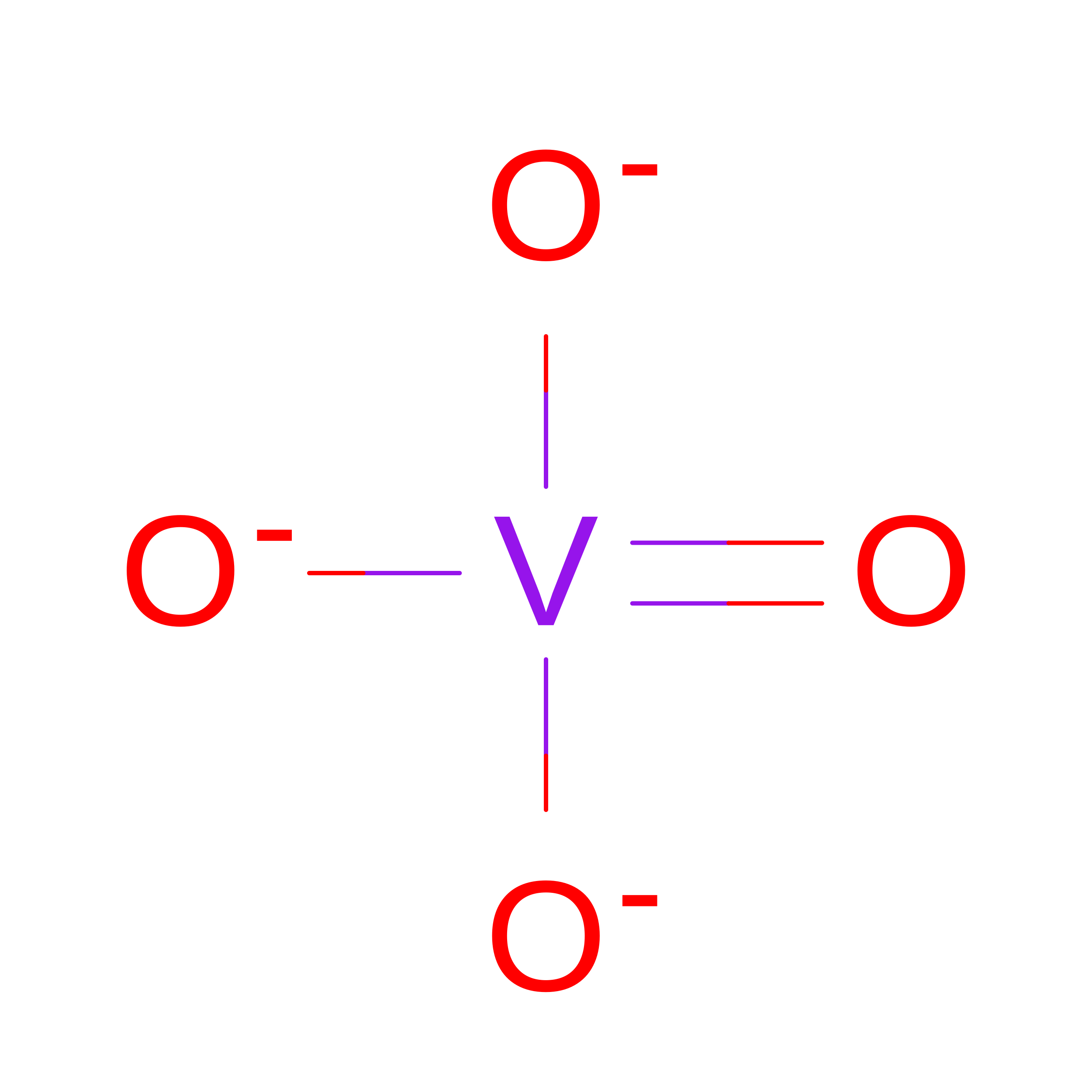
B [auth A]VANADATE ION
O4 V
LSGOVYNHVSXFFJ-UHFFFAOYSA-N

Experimental Data & Validation

Experimental Data

  • Method: X-RAY DIFFRACTION
  • Resolution: 2.03 Å
  • R-Value Work:  0.170 (Depositor), 0.159 (DCC) 
Space Group: H 3
Unit Cell:
Length ( Å )Angle ( ˚ )
a = 131.72α = 90
b = 131.72β = 90
c = 112.46γ = 120
Software Package:
Software NamePurpose
CCP4:model building
FFTmodel building
X-PLORrefinement
MOSFLMdata reduction
CCP4data scaling
ROTAVATAdata scaling
CCP4phasing
SFCALCphasing
FFTphasing

Structure Validation

View Full Validation Report


Entry History 

Deposition Data

Revision History  (Full details and data files)

  • Version 1.0: 2001-04-11
    Type: Initial release
  • Version 1.1: 2008-04-27
    Changes: Version format compliance
  • Version 1.2: 2011-07-13
    Changes: Derived calculations, Version format compliance
  • Version 1.3: 2017-10-04
    Changes: Advisory, Refinement description
  • Version 1.4: 2023-08-09
    Changes: Advisory, Data collection, Database references, Derived calculations, Refinement description