1I1N | pdb_00001i1n

HUMAN PROTEIN L-ISOASPARTATE O-METHYLTRANSFERASE WITH S-ADENOSYL HOMOCYSTEINE


Experimental Data Snapshot

  • Method: X-RAY DIFFRACTION
  • Resolution: 1.50 Å
  • R-Value Free: 
    0.213 (Depositor), 0.213 (DCC) 
  • R-Value Work: 
    0.183 (Depositor), 0.183 (DCC) 
  • R-Value Observed: 
    0.183 (Depositor) 

Starting Model: experimental
View more details

wwPDB Validation 3D Report Full Report

Validation slider image for 1I1N

Ligand Structure Quality Assessment 


This is version 1.3 of the entry. See complete history

Literature

Crystal structure of human L-isoaspartyl-O-methyl-transferase with S-adenosyl homocysteine at 1.6-A resolution and modeling of an isoaspartyl-containing peptide at the active site.

Smith, C.D.Carson, M.Friedman, A.M.Skinner, M.M.Delucas, L.Chantalat, L.Weise, L.Shirasawa, T.Chattopadhyay, D.

(2002) Protein Sci 11: 625-635

  • DOI: https://doi.org/10.1110/ps.37802
  • Primary Citation Related Structures: 
    1I1N

  • PubMed Abstract: 

    Spontaneous formation of isoaspartyl residues (isoAsp) disrupts the structure and function of many normal proteins. Protein isoaspartyl methyltransferase (PIMT) reverts many isoAsp residues to aspartate as a protein repair process. We have determined the crystal structure of human protein isoaspartyl methyltransferase (HPIMT) complexed with adenosyl homocysteine (AdoHcy) to 1.6-A resolution. The core structure has a nucleotide binding domain motif, which is structurally homologous with the N-terminal domain of the bacterial Thermotoga maritima PIMT. Highly conserved residues in PIMTs among different phyla are placed at positions critical to AdoHcy binding and orienting the isoAsp residue substrate for methylation. The AdoHcy is completely enclosed within the HPIMT and a conformational change must occur to allow exchange with adenosyl methionine (AdoMet). An ordered sequential enzyme mechanism is supported because C-terminal residues involved with AdoHcy binding also form the isoAsp peptide binding site, and a change of conformation to allow AdoHcy to escape would preclude peptide binding. Modeling experiments indicated isoAsp groups observed in some known protein crystal structures could bind to the HPIMT active site.


  • Organizational Affiliation
    • Center for Biophysical Sciences and Technology, University of Alabama at Birmingham, Birmingham, Alabama 35294-0044, USA. smith@cbse.uab.edu

Macromolecule Content 

  • Total Structure Weight: 24.92 kDa 
  • Atom Count: 2,010 
  • Modeled Residue Count: 224 
  • Deposited Residue Count: 226 
  • Unique protein chains: 1

Macromolecules

Find similar proteins by:|  3D Structure
Entity ID: 1
MoleculeChains  Sequence LengthOrganismDetailsImage
PROTEIN-L-ISOASPARTATE O-METHYLTRANSFERASE226Homo sapiensMutation(s): 0 
Gene Names: PIMT_HUMAN
EC: 2.1.1.77
UniProt & NIH Common Fund Data Resources
Find proteins for P22061 (Homo sapiens)
Explore P22061 
Go to UniProtKB:  P22061
PHAROS:  P22061
GTEx:  ENSG00000120265 
Entity Groups
Sequence Clusters30% Identity50% Identity70% Identity90% Identity95% Identity100% Identity
UniProt GroupP22061
Sequence Annotations
Expand
Reference Sequence

Small Molecules

Ligands 1 Unique
IDChains Name / Formula / InChI Key2D Diagram3D Interactions
SAH

Query on SAH


Download:Ideal Coordinates CCD File
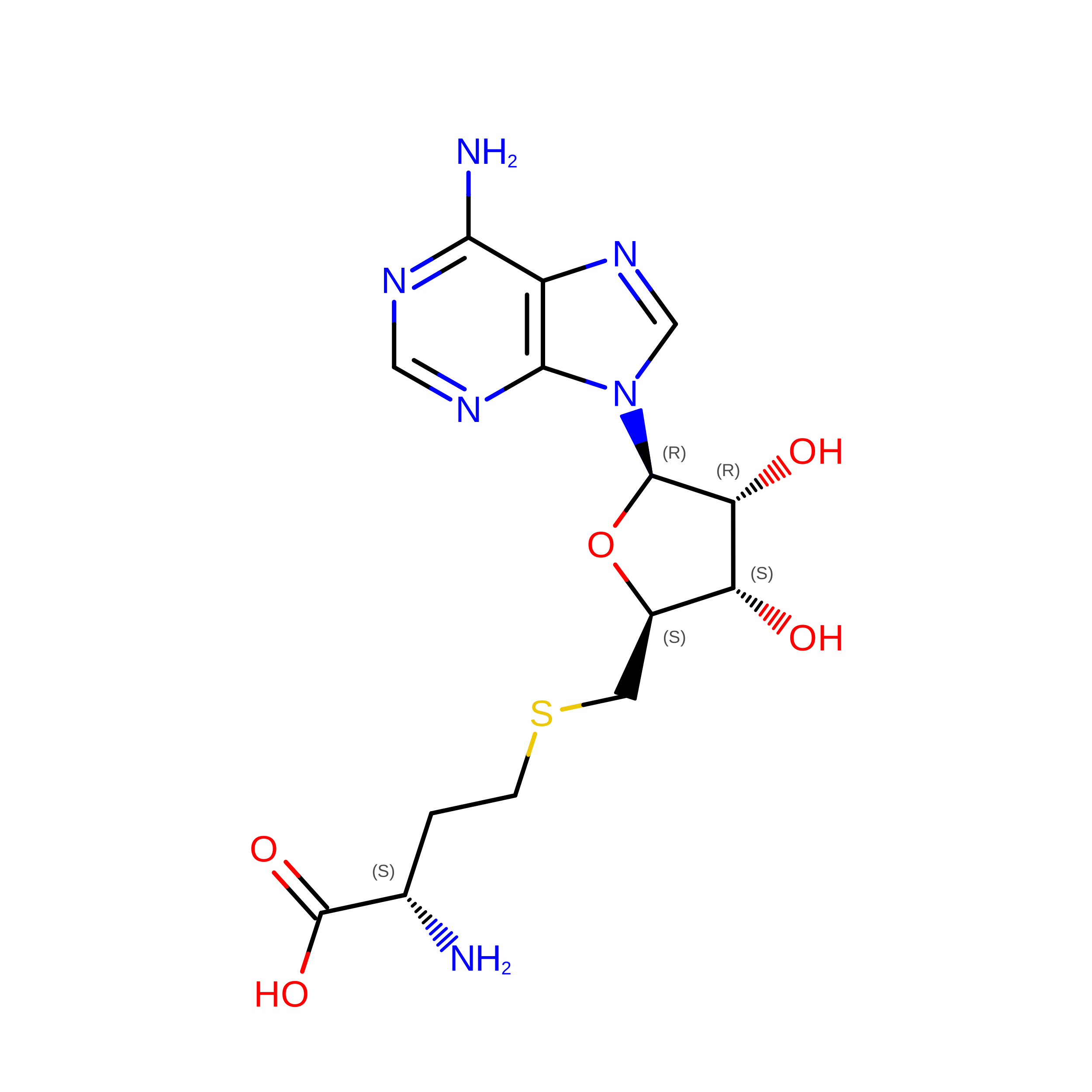
B [auth A]S-ADENOSYL-L-HOMOCYSTEINE
C14 H20 N6 O5 S
ZJUKTBDSGOFHSH-WFMPWKQPSA-N

Experimental Data & Validation

Experimental Data

  • Method: X-RAY DIFFRACTION
  • Resolution: 1.50 Å
  • R-Value Free:  0.213 (Depositor), 0.213 (DCC) 
  • R-Value Work:  0.183 (Depositor), 0.183 (DCC) 
  • R-Value Observed: 0.183 (Depositor) 
Space Group: P 1 21 1
Unit Cell:
Length ( Å )Angle ( ˚ )
a = 48.105α = 90
b = 53.917β = 116.15
c = 48.814γ = 90
Software Package:
Software NamePurpose
CNSrefinement
DENZOdata reduction
SCALEPACKdata scaling
CNSphasing

Structure Validation

View Full Validation Report


Ligand Structure Quality Assessment 


Entry History 

Deposition Data

Revision History  (Full details and data files)

  • Version 1.0: 2002-03-13
    Type: Initial release
  • Version 1.1: 2008-04-27
    Changes: Version format compliance
  • Version 1.2: 2011-07-13
    Changes: Version format compliance
  • Version 1.3: 2023-08-09
    Changes: Data collection, Database references, Derived calculations, Refinement description