1I1E | pdb_00001i1e

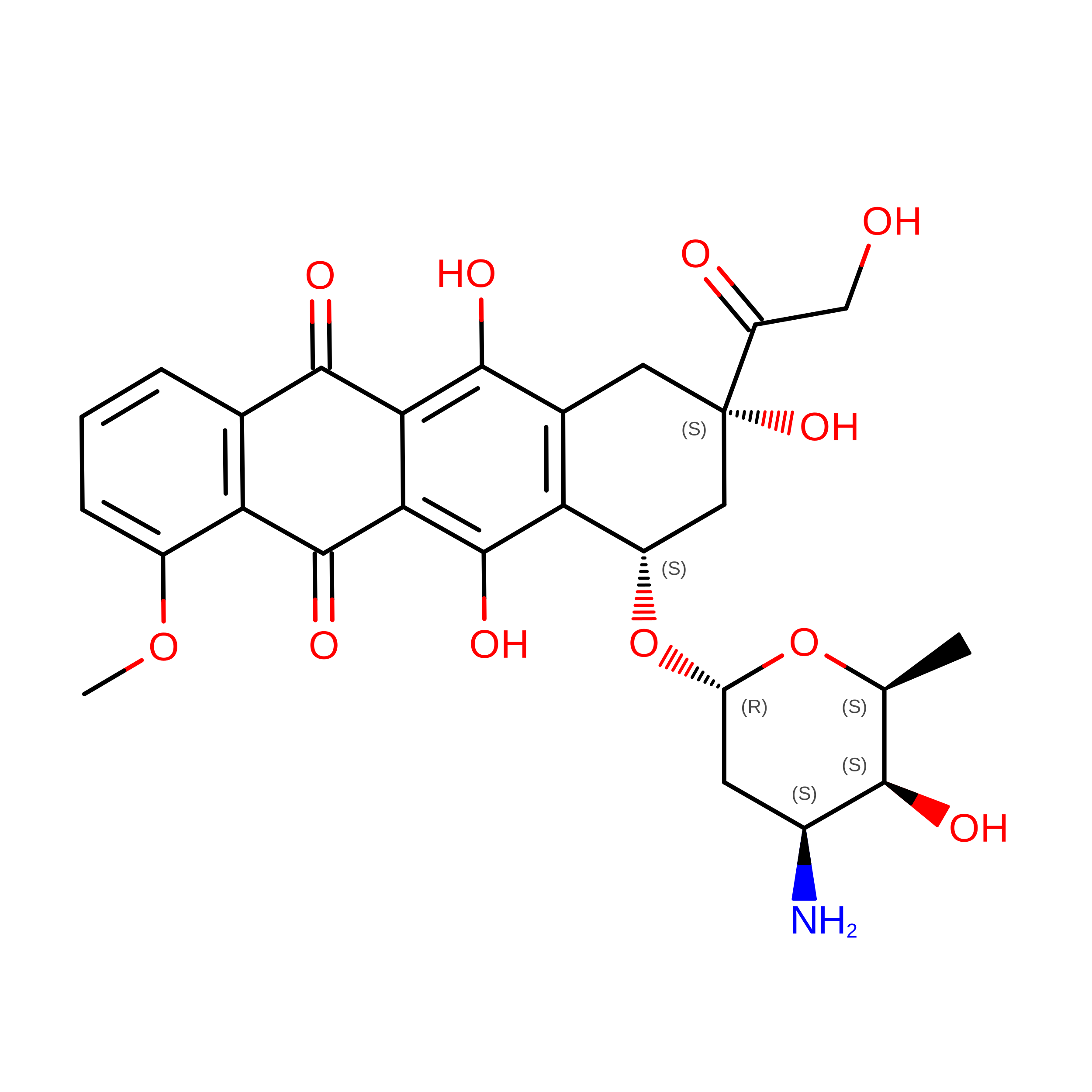
CRYSTAL STRUCTURE OF CLOSTRIDIUM BOTULINUM NEUROTOXIN B COMPLEXED WITH DOXORUBICIN


Experimental Data Snapshot

  • Method: X-RAY DIFFRACTION
  • Resolution: 2.50 Å
  • R-Value Free: 
    0.276 (Depositor), 0.275 (DCC) 
  • R-Value Work: 
    0.217 (Depositor), 0.221 (DCC) 

Starting Model: experimental
View more details

wwPDB Validation 3D Report Full Report

Validation slider image for 1I1E

Ligand Structure Quality Assessment 


This is version 1.4 of the entry. See complete history

Literature

Crystallographic evidence for doxorubicin binding to the receptor-binding site in Clostridium botulinum neurotoxin B.

Eswaramoorthy, S.Kumaran, D.Swaminathan, S.

(2001) Acta Crystallogr D Biol Crystallogr 57: 1743-1746

  • DOI: https://doi.org/10.1107/s0907444901013531
  • Primary Citation Related Structures: 
    1I1E

  • PubMed Abstract: 

    The neurotoxins of Clostridium botulinum and tetanus bind to gangliosides as a first step of their toxin activity. Identifying suitable receptors that compete with gangliosides could prevent toxin binding to the neuronal cells. A possible ganglioside-binding site of the botulinum neurotoxin B (BoNT/B) has already been proposed and evidence is now presented for a drug binding to botulinum neurotoxin B from structural studies. Doxorubicin, a well known DNA intercalator, binds to the neurotoxin at the receptor-binding site proposed earlier. The structure of the BoNT/B-doxorubicin complex reveals that doxorubicin has interactions with the neurotoxin similar to those of sialyllactose. The aglycone moiety of the doxorubicin stacks with tryptophan 1261 and interacts with histidine 1240 of the binding domain. Here, the possibility is presented of designing a potential antagonist for these neurotoxins from crystallographic analysis of the neurotoxin-doxorubicin complex, which will be an excellent lead compound.


  • Organizational Affiliation
    • Biology Department, Brookhaven National Laboratory, Upton, NY 11973, USA.

Macromolecule Content 

  • Total Structure Weight: 151.54 kDa 
  • Atom Count: 11,016 
  • Modeled Residue Count: 1,287 
  • Deposited Residue Count: 1,290 
  • Unique protein chains: 1

Macromolecules

Find similar proteins by:|  3D Structure
Entity ID: 1
MoleculeChains  Sequence LengthOrganismDetailsImage
BOTULINUM NEUROTOXIN TYPE B1,290Clostridium botulinumMutation(s): 0 
EC: 3.4.24.69
UniProt
Find proteins for P10844 (Clostridium botulinum)
Explore P10844 
Go to UniProtKB:  P10844
Entity Groups
Sequence Clusters30% Identity50% Identity70% Identity90% Identity95% Identity100% Identity
UniProt GroupP10844
Sequence Annotations
Expand
Reference Sequence

Experimental Data & Validation

Experimental Data

  • Method: X-RAY DIFFRACTION
  • Resolution: 2.50 Å
  • R-Value Free:  0.276 (Depositor), 0.275 (DCC) 
  • R-Value Work:  0.217 (Depositor), 0.221 (DCC) 
Space Group: P 1 21 1
Unit Cell:
Length ( Å )Angle ( ˚ )
a = 76.27α = 90
b = 122.93β = 112.95
c = 95.42γ = 90
Software Package:
Software NamePurpose
DENZOdata reduction
SCALEPACKdata scaling
AMoREphasing
CNSrefinement

Structure Validation

View Full Validation Report


Ligand Structure Quality Assessment 


Entry History 

Deposition Data

Revision History  (Full details and data files)

  • Version 1.0: 2001-11-21
    Type: Initial release
  • Version 1.1: 2008-04-27
    Changes: Version format compliance
  • Version 1.2: 2011-07-13
    Changes: Version format compliance
  • Version 1.3: 2023-08-09
    Changes: Data collection, Database references, Derived calculations, Refinement description
  • Version 1.4: 2024-10-30
    Changes: Structure summary