1HH8 | pdb_00001hh8

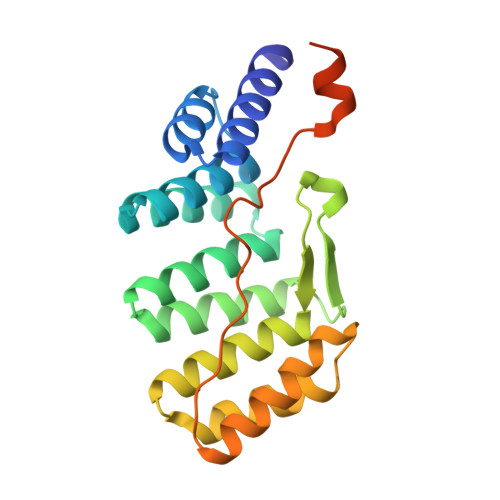
The active N-terminal region of p67phox: Structure at 1.8 Angstrom resolution and biochemical characterizations of the A128V mutant implicated in chronic granulomatous disease


Experimental Data Snapshot

  • Method: X-RAY DIFFRACTION
  • Resolution: 1.80 Å
  • R-Value Free: 
    0.204 (Depositor), 0.209 (DCC) 
  • R-Value Work: 
    0.182 (Depositor), 0.187 (DCC) 
  • R-Value Observed: 
    0.182 (Depositor) 

wwPDB Validation 3D Report Full Report

Validation slider image for 1HH8

This is version 1.4 of the entry. See complete history

Literature

The Active N-Terminal Region of P67Phox: Structure at 1.8 Angstrom Resolution and Biochemical Characterizations of the A128V Mutant Implicated in Chronic Granulomatous Disease

Grizot, S.Fieschi, F.Dagher, M.-C.Pebay-Peyroula, E.

(2001) J Biological Chem 276: 21627

  • DOI: https://doi.org/10.1074/jbc.M100893200
  • Primary Citation Related Structures: 
    1HH8

  • PubMed Abstract: 

    Upon activation, the NADPH oxidase from neutrophils produces superoxide anions in response to microbial infection. This enzymatic complex is activated by association of its cytosolic factors p67(phox), p47(phox), and the small G protein Rac with a membrane-associated flavocytochrome b(558). Here we report the crystal structure of the active N-terminal fragment of p67(phox) at 1.8 A resolution, as well as functional studies of p67(phox) mutants. This N-terminal region (residues 1-213) consists mainly of four TPR (tetratricopeptide repeat) motifs in which the C terminus folds back into a hydrophobic groove formed by the TPR domain. The structure is very similar to that of the inactive truncated form of p67(phox) bound to the small G protein Rac previously reported, but differs by the presence of a short C-terminal helix (residues 187-193) that might be part of the activation domain. All p67(phox) mutants responsible for Chronic Granulomatous Disease (CGD), a severe defect of NADPH oxidase function, are localized in the N-terminal region. We investigated two CGD mutations, G78E and A128V. Surprisingly, the A128V CGD mutant is able to fully activate the NADPH oxidase in vitro at 25 degrees C. However, this point mutation represents a temperature-sensitive defect in p67(phox) that explains its phenotype at physiological temperature.


  • Organizational Affiliation
    • Institut de Biologie Structurale, CEA-CNRS-UJF, UMR 5075, 41 rue Jules Horowitz, 38027 Grenoble cedex 1, France.

Macromolecule Content 

  • Total Structure Weight: 24.71 kDa 
  • Atom Count: 1,785 
  • Modeled Residue Count: 192 
  • Deposited Residue Count: 213 
  • Unique protein chains: 1

Macromolecules

Find similar proteins by:|  3D Structure
Entity ID: 1
MoleculeChains  Sequence LengthOrganismDetailsImage
NEUTROPHIL CYTOSOL FACTOR 2213Homo sapiensMutation(s): 1 
UniProt & NIH Common Fund Data Resources
Find proteins for P19878 (Homo sapiens)
Explore P19878 
Go to UniProtKB:  P19878
PHAROS:  P19878
GTEx:  ENSG00000116701 
Entity Groups
Sequence Clusters30% Identity50% Identity70% Identity90% Identity95% Identity100% Identity
UniProt GroupP19878
Sequence Annotations
Expand
Reference Sequence

Small Molecules

Ligands 1 Unique
IDChains Name / Formula / InChI Key2D Diagram3D Interactions
FLC

Query on FLC


Download:Ideal Coordinates CCD File
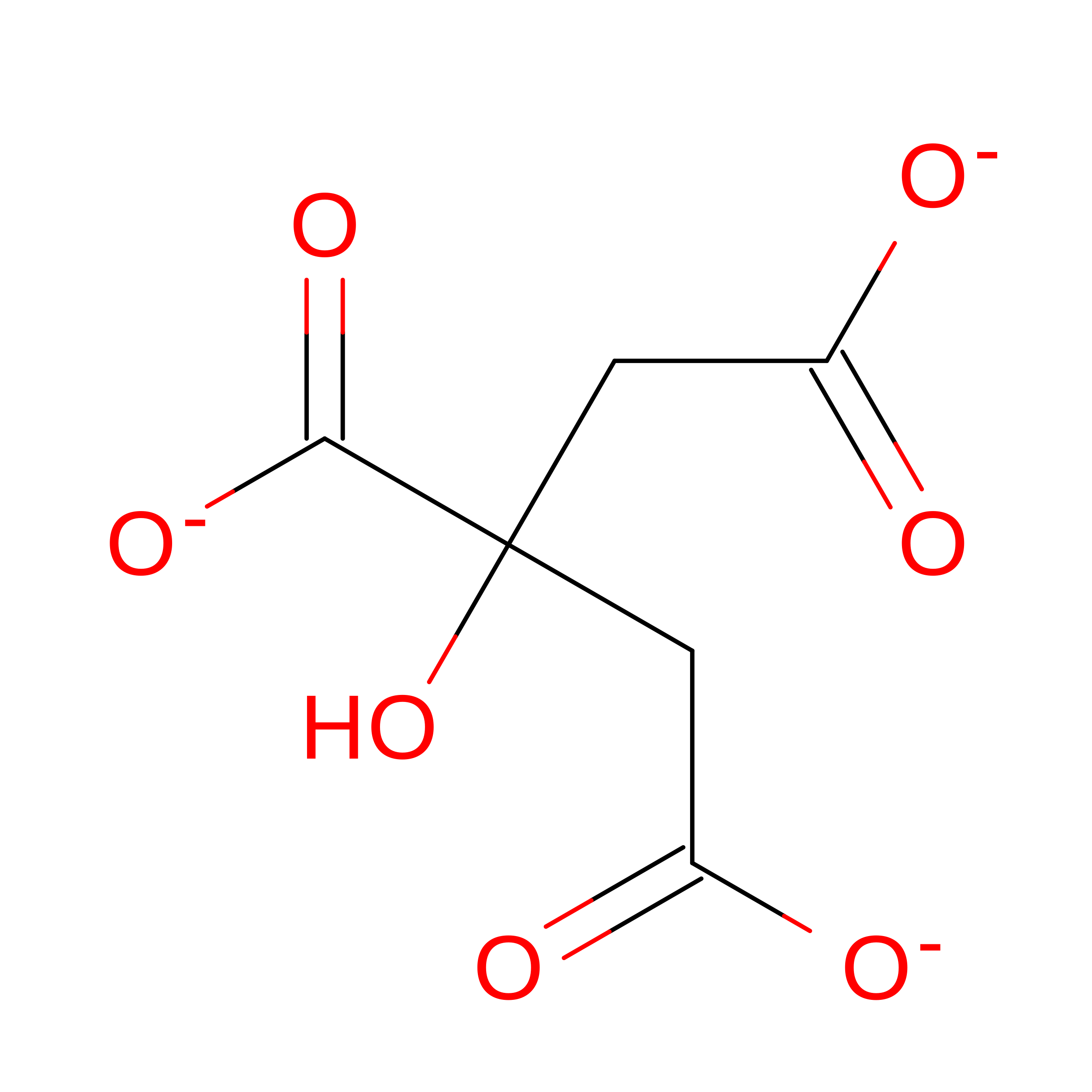
B [auth A]CITRATE ANION
C6 H5 O7
KRKNYBCHXYNGOX-UHFFFAOYSA-K

Experimental Data & Validation

Experimental Data

  • Method: X-RAY DIFFRACTION
  • Resolution: 1.80 Å
  • R-Value Free:  0.204 (Depositor), 0.209 (DCC) 
  • R-Value Work:  0.182 (Depositor), 0.187 (DCC) 
  • R-Value Observed: 0.182 (Depositor) 
Space Group: P 31
Unit Cell:
Length ( Å )Angle ( ˚ )
a = 67.67α = 90
b = 67.67β = 90
c = 50.2γ = 120
Software Package:
Software NamePurpose
CNSrefinement
DENZOdata reduction
CCP4data scaling
MLPHAREphasing

Structure Validation

View Full Validation Report


Entry History 

Deposition Data

Revision History  (Full details and data files)

  • Version 1.0: 2001-06-13
    Type: Initial release
  • Version 1.1: 2011-05-08
    Changes: Version format compliance
  • Version 1.2: 2011-07-13
    Changes: Version format compliance
  • Version 1.3: 2017-09-20
    Changes: Advisory, Database references
  • Version 1.4: 2024-05-08
    Changes: Advisory, Data collection, Database references, Other