1GU9 | pdb_00001gu9

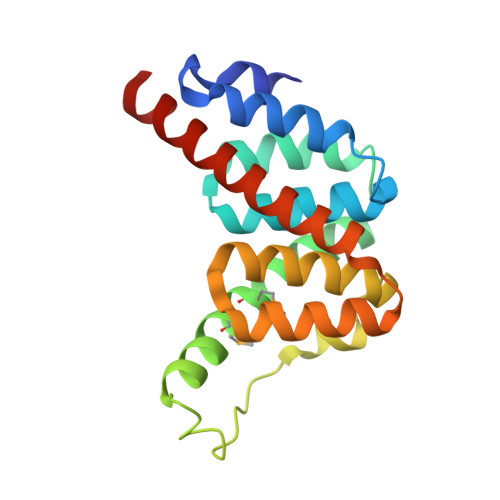
Crystal Structure of Mycobacterium tuberculosis Alkylperoxidase AhpD


Experimental Data Snapshot

  • Method: X-RAY DIFFRACTION
  • Resolution: 1.90 Å
  • R-Value Free: 
    0.313 (Depositor), 0.315 (DCC) 
  • R-Value Work: 
    0.243 (Depositor), 0.245 (DCC) 
  • R-Value Observed: 
    0.243 (Depositor) 

wwPDB Validation 3D Report Full Report

Validation slider image for 1GU9

This is version 1.4 of the entry. See complete history

Literature

The Crystal Structure of Mycobacterium Tuberculosis Alkylhydroperoxidase Ahpd, a Potential Target for Antitubercular Drug Design

Nunn, C.M.Djordjevic, S.Hillas, P.J.Nishida, C.Ortiz de Montellano, P.R.

(2002) J Biological Chem 277: 20033

  • DOI: https://doi.org/10.1074/jbc.M200864200
  • Primary Citation Related Structures: 
    1GU9

  • PubMed Abstract: 

    The resistance of Mycobacterium tuberculosis to isoniazid is commonly linked to inactivation of a catalase-peroxidase, KatG, that converts isoniazid to its biologically active form. Loss of KatG is associated with elevated expression of the alkylhydroperoxidases AhpC and AhpD. AhpD has no sequence identity with AhpC or other proteins but has alkylhydroperoxidase activity and possibly additional physiological activities. The alkylhydroperoxidase activity, in the absence of KatG, provides an important antioxidant defense. We have determined the M. tuberculosis AhpD structure to a resolution of 1.9 A. The protein is a trimer in a symmetrical cloverleaf arrangement. Each subunit exhibits a new all-helical protein fold in which the two catalytic sulfhydryl groups, Cys-130 and Cys-133, are located near a central cavity in the trimer. The structure supports a mechanism for the alkylhydroperoxidase activity in which Cys-133 is deprotonated by a distant glutamic acid via the relay action of His-137 and a water molecule. The cysteine then reacts with the peroxide to give a sulfenic acid that subsequently forms a disulfide bond with Cys-130. The crystal structure of AhpD identifies a new protein fold relevant to members of this protein family in other organisms. The structural details constitute a potential platform for the design of inhibitors of potential utility as antitubercular agents and suggest that AhpD may have disulfide exchange properties of importance in other areas of M. tuberculosis biology.


  • Organizational Affiliation
    • Department of Biochemistry and Molecular Biology, University College, Gower Street, London WC1E 6BT, United Kingdom.

Macromolecule Content 

  • Total Structure Weight: 227.31 kDa 
  • Atom Count: 16,174 
  • Modeled Residue Count: 2,052 
  • Deposited Residue Count: 2,124 
  • Unique protein chains: 1

Macromolecules

Find similar proteins by:|  3D Structure
Entity ID: 1
MoleculeChains  Sequence LengthOrganismDetailsImage
ALKYLHYDROPEROXIDASE D
A, B, C, D, E
A, B, C, D, E, F, G, H, I, J, K, L
177Mycobacterium tuberculosis H37RvMutation(s): 0 
EC: 1.11.1.28
UniProt
Find proteins for P9WQB5 (Mycobacterium tuberculosis (strain ATCC 25618 / H37Rv))
Explore P9WQB5 
Go to UniProtKB:  P9WQB5
Entity Groups
Sequence Clusters30% Identity50% Identity70% Identity90% Identity95% Identity100% Identity
UniProt GroupP9WQB5
Sequence Annotations
Expand
Reference Sequence

Small Molecules

Modified Residues  1 Unique
IDChains TypeFormula2D DiagramParent
MSE
Query on MSE
A, B, C, D, E
A, B, C, D, E, F, G, H, I, J, K, L
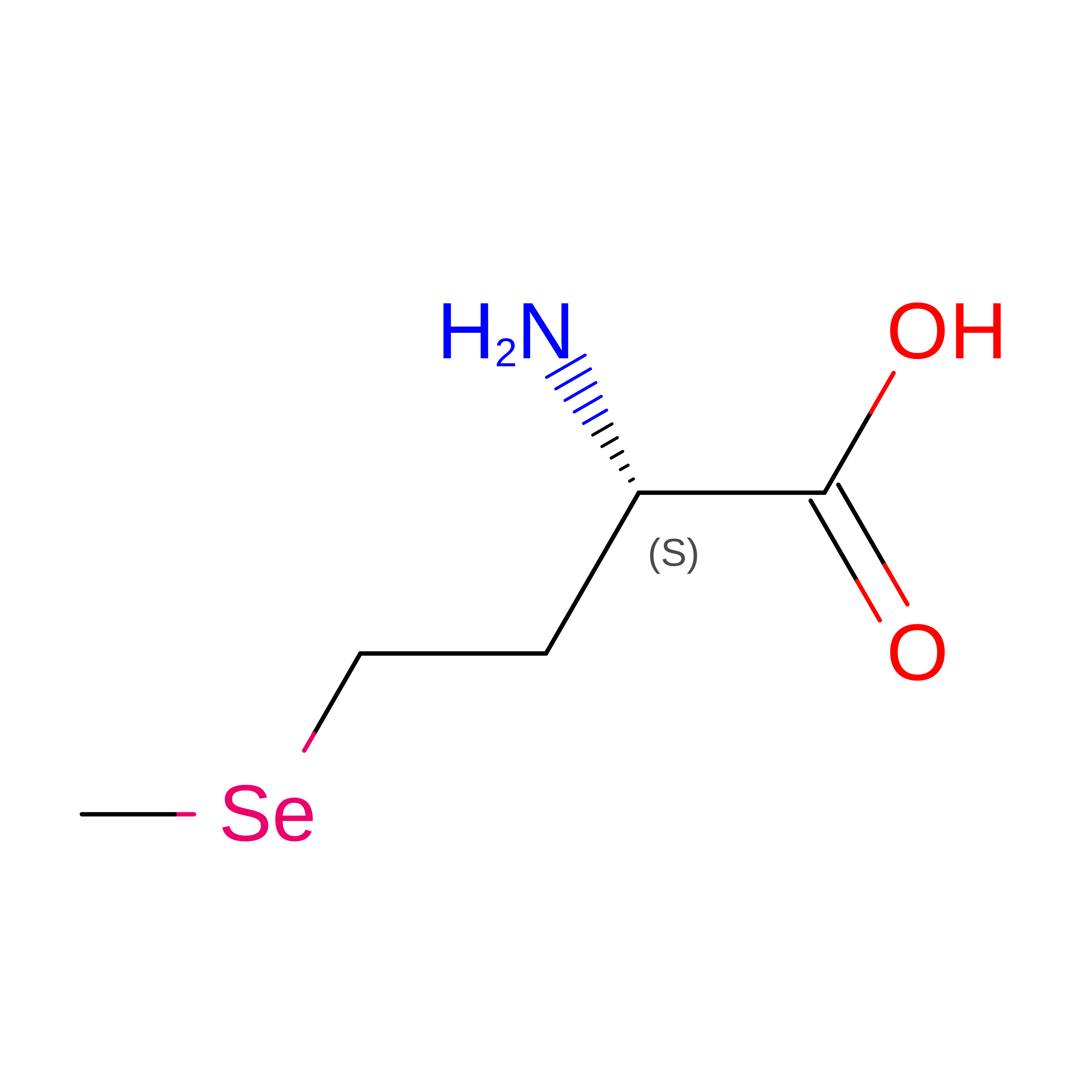
L-PEPTIDE LINKINGC5 H11 N O2 SeMET

Experimental Data & Validation

Experimental Data

  • Method: X-RAY DIFFRACTION
  • Resolution: 1.90 Å
  • R-Value Free:  0.313 (Depositor), 0.315 (DCC) 
  • R-Value Work:  0.243 (Depositor), 0.245 (DCC) 
  • R-Value Observed: 0.243 (Depositor) 
Space Group: C 1 2 1
Unit Cell:
Length ( Å )Angle ( ˚ )
a = 186.377α = 90
b = 117.28β = 113.97
c = 88.986γ = 90
Software Package:
Software NamePurpose
CNSrefinement
HKLdata reduction
SCALEPACKdata scaling
CNSphasing

Structure Validation

View Full Validation Report


Entry History 

Deposition Data

Revision History  (Full details and data files)

  • Version 1.0: 2002-02-14
    Type: Initial release
  • Version 1.1: 2011-05-08
    Changes: Version format compliance
  • Version 1.2: 2011-07-13
    Changes: Version format compliance
  • Version 1.3: 2018-02-07
    Changes: Advisory, Database references, Structure summary
  • Version 1.4: 2024-10-09
    Changes: Advisory, Data collection, Database references, Derived calculations, Other, Structure summary