1FHZ | pdb_00001fhz

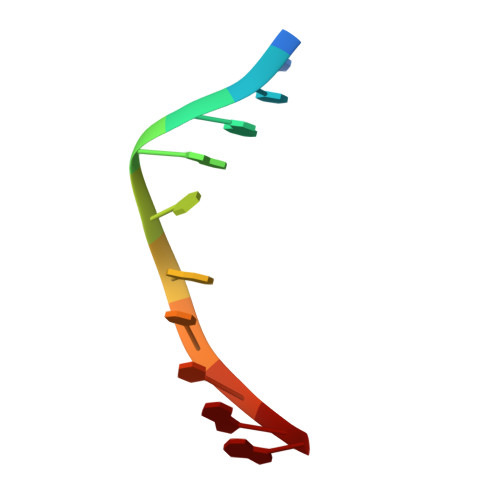
PSORALEN CROSS-LINKED D(CCGGTACCGG) FORMS HOLLIDAY JUNCTION


Experimental Data Snapshot

  • Method: X-RAY DIFFRACTION
  • Resolution: 2.20 Å
  • R-Value Free: 
    0.311 (Depositor) 
  • R-Value Work: 
    0.228 (Depositor), 0.253 (DCC) 
  • R-Value Observed: 
    0.236 (Depositor) 

wwPDB Validation 3D Report Full Report

Validation slider image for 1FHZ

Ligand Structure Quality Assessment 


This is version 1.3 of the entry. See complete history

Literature

The crystal structures of psoralen cross-linked DNAs: drug-dependent formation of Holliday junctions.

Eichman, B.F.Mooers, B.H.Alberti, M.Hearst, J.E.Ho, P.S.

(2001) J Mol Biology 308: 15-26

  • DOI: https://doi.org/10.1006/jmbi.2001.4567
  • Primary Citation Related Structures: 
    1FHY, 1FHZ

  • PubMed Abstract: 

    The single-crystal structures are presented for two DNA sequences with the thymine bases covalently cross-linked across the complementary strands by 4'-hydroxymethyl-4,5',8-trimethylpsoralen (HMT). The HMT-adduct of d(CCGCTAGCGG) forms a psoralen-induced Holliday junction, showing for the first time the effect of this important class of chemotheraputics on the structure of the recombination intermediate. In contrast, HMT-d(CCGGTACCGG) forms a sequence-dependent junction. In both structures, the DNA duplex is highly distorted at the thymine base linked to the six-member pyrone ring of the drug. The psoralen cross-link defines the intramolecular interactions of the drug-induced junction, while the sequence-dependent structure is nearly identical to the native Holliday junction of d(CCGGTACCGG) alone. The two structures contrast the effects of drug- and sequence-dependent interactions on the structure of a Holliday junction, suggesting a role for psoralen in the mechanism to initiate repair of psoralen-lesions in mammalian DNA.


  • Organizational Affiliation
    • Department of Biochemistry and Biophysics, ALS 2011, Oregon State University, Corvallis, OR 97331, USA.

Macromolecule Content 

  • Total Structure Weight: 6.35 kDa 
  • Atom Count: 466 
  • Modeled Residue Count: 20 
  • Deposited Residue Count: 20 
  • Unique nucleic acid chains: 1

Macromolecules

Find similar nucleic acids by:  Sequence
Entity ID: 1
MoleculeChains LengthOrganismImage
DNA (5'-D(*CP*CP*GP*GP*TP*AP*CP*CP*GP*G)-3')
A, B
10N/A
Sequence Annotations
Expand
Reference Sequence

Small Molecules

Ligands 1 Unique
IDChains Name / Formula / InChI Key2D Diagram3D Interactions
PSO

Query on PSO


Download:Ideal Coordinates CCD File
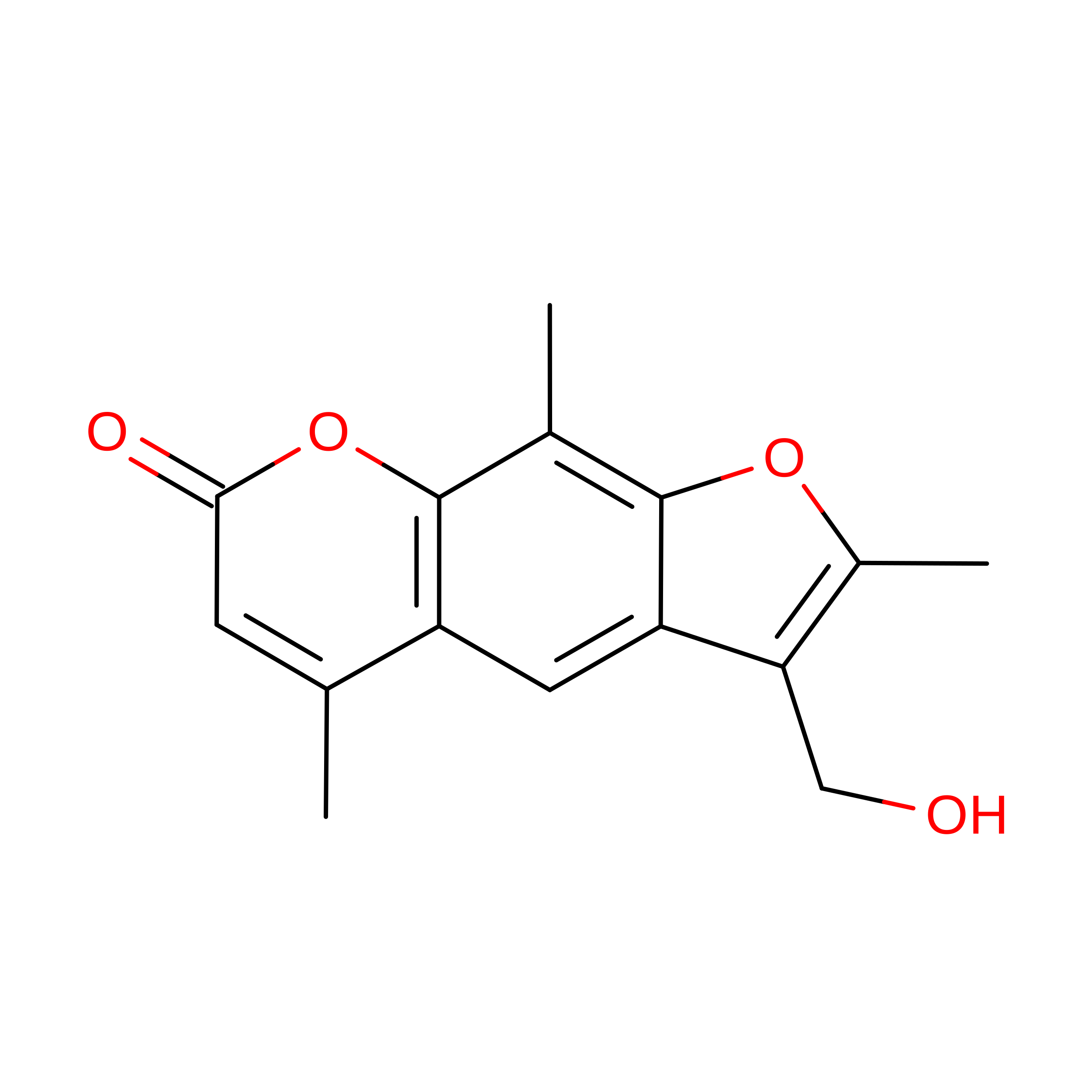
C [auth B]4'-HYDROXYMETHYL-4,5',8-TRIMETHYLPSORALEN
C15 H14 O4
RGJSDHXSAKMPNM-UHFFFAOYSA-N

Experimental Data & Validation

Experimental Data

  • Method: X-RAY DIFFRACTION
  • Resolution: 2.20 Å
  • R-Value Free:  0.311 (Depositor) 
  • R-Value Work:  0.228 (Depositor), 0.253 (DCC) 
  • R-Value Observed: 0.236 (Depositor) 
Space Group: C 1 2 1
Unit Cell:
Length ( Å )Angle ( ˚ )
a = 72.116α = 90
b = 23.651β = 112.64
c = 36.182γ = 90
Software Package:
Software NamePurpose
DENZOdata reduction
SCALEPACKdata scaling
X-PLORmodel building
X-PLORrefinement
X-PLORphasing

Structure Validation

View Full Validation Report


Ligand Structure Quality Assessment 


Entry History 

Deposition Data

Revision History  (Full details and data files)

  • Version 1.0: 2001-04-21
    Type: Initial release
  • Version 1.1: 2008-04-27
    Changes: Version format compliance
  • Version 1.2: 2011-07-13
    Changes: Version format compliance
  • Version 1.3: 2024-02-07
    Changes: Data collection, Database references, Derived calculations