1E2Y | pdb_00001e2y

Tryparedoxin peroxidase from Crithidia fasciculata


Experimental Data Snapshot

  • Method: X-RAY DIFFRACTION
  • Resolution: 3.20 Å
  • R-Value Free: 
    0.286 (Depositor), 0.273 (DCC) 
  • R-Value Work: 
    0.273 (Depositor), 0.258 (DCC) 
  • R-Value Observed: 
    0.273 (Depositor) 

wwPDB Validation 3D Report Full Report

Validation slider image for 1E2Y

This is version 1.4 of the entry. See complete history

Literature

The Structure of Reduced Tryparedoxin Peroxidase Reveals a Decamer and Insight Into Reactivity of 2Cys-Peroxiredoxins

Alphey, M.S.Bond, C.S.Tetaud, E.Fairlamb, A.H.Hunter, W.N.

(2000) J Mol Biology 300: 903

  • DOI: https://doi.org/10.1006/jmbi.2000.3881
  • Primary Citation Related Structures: 
    1E2Y

  • PubMed Abstract: 

    Tryparedoxin peroxidase (TryP) is a recently discovered 2Cys-peroxiredoxin involved in defence against oxidative stress in parasitic trypanosomatids. The crystal structure of recombinant Crithidia fasciculata TryP, in the reduced state, has been determined using multi-wavelength anomalous dispersion methods applied to a selenomethionyl derivative. The model comprises a decamer with 52 symmetry, ten chloride ions with 23 water molecules and has been refined, using data to 3.2 A resolution (1 A=0.1 nm), to an R-factor and R(free) of 27.3 and 28.6 %, respectively. Secondary structure topology places TryP along with tryparedoxin and glutathione peroxidase in a distinct subgroup of the thioredoxin super-family. The molecular details at the active site support ideas about the enzyme mechanism and comparisons with an oxidised 2Cys-peroxiredoxin reveal structural alterations induced by the change in oxidation state. These include a difference in quaternary structure from dimer (oxidised form) to decamer (reduced form). The 2Cys-peroxiredoxin assembly may prevent indiscriminate oligomerisation, localise ten peroxidase active sites and contribute to both the specificity of reduction by the redox partner tryparedoxin and attraction of peroxides into the active site.


  • Organizational Affiliation
    • Department of Biochemistry, The Wellcome Trust Biocentre, University of Dundee, Dundee, DD1 5EH, UK.

Macromolecule Content 

  • Total Structure Weight: 213.49 kDa 
  • Atom Count: 13,211 
  • Modeled Residue Count: 1,678 
  • Deposited Residue Count: 1,880 
  • Unique protein chains: 1

Macromolecules

Find similar proteins by:|  3D Structure
Entity ID: 1
MoleculeChains  Sequence LengthOrganismDetailsImage
TRYPAREDOXIN PEROXIDASE
A, B, C, D, E
A, B, C, D, E, F, G, H, I, J
188Crithidia fasciculataMutation(s): 0 
Gene Names: CF-TRYP
EC: 1.11.1.24
UniProt
Find proteins for Q9TZX2 (Crithidia fasciculata)
Explore Q9TZX2 
Go to UniProtKB:  Q9TZX2
Entity Groups
Sequence Clusters30% Identity50% Identity70% Identity90% Identity95% Identity100% Identity
UniProt GroupQ9TZX2
Sequence Annotations
Expand
Reference Sequence

Small Molecules

Ligands 1 Unique
IDChains Name / Formula / InChI Key2D Diagram3D Interactions
CL

Query on CL


Download:Ideal Coordinates CCD File
K [auth A]
L [auth B]
M [auth C]
N [auth D]
O [auth E]
K [auth A],
L [auth B],
M [auth C],
N [auth D],
O [auth E],
P [auth F],
Q [auth G],
R [auth H],
S [auth I],
T [auth J]
CHLORIDE ION
Cl
VEXZGXHMUGYJMC-UHFFFAOYSA-M
Modified Residues  1 Unique
IDChains TypeFormula2D DiagramParent
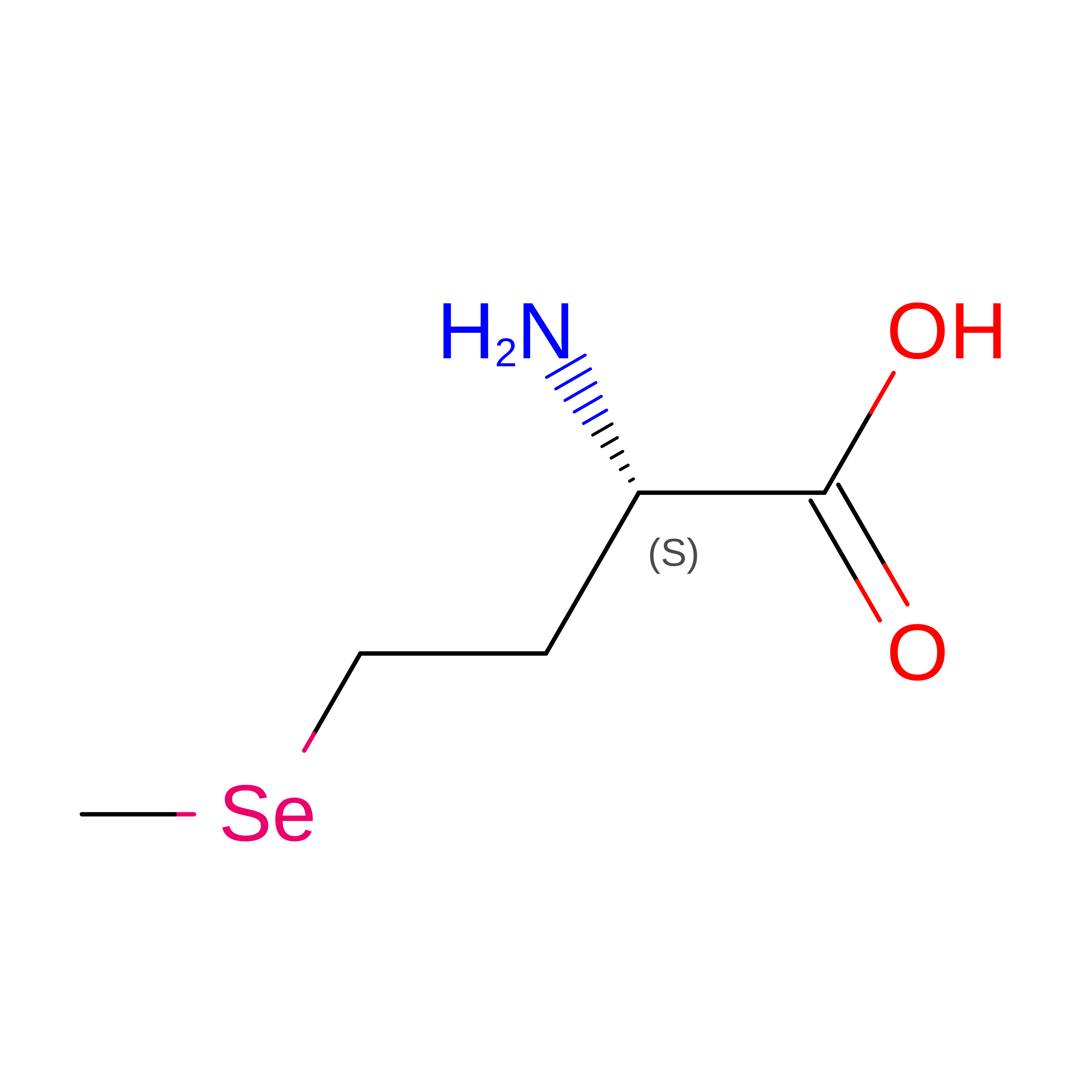
MSE
Query on MSE
A, B, C, D, E
A, B, C, D, E, F, G, H, I, J
L-PEPTIDE LINKINGC5 H11 N O2 SeMET

Experimental Data & Validation

Experimental Data

  • Method: X-RAY DIFFRACTION
  • Resolution: 3.20 Å
  • R-Value Free:  0.286 (Depositor), 0.273 (DCC) 
  • R-Value Work:  0.273 (Depositor), 0.258 (DCC) 
  • R-Value Observed: 0.273 (Depositor) 
Space Group: P 1 21 1
Unit Cell:
Length ( Å )Angle ( ˚ )
a = 123.8α = 90
b = 97.2β = 93.1
c = 133.8γ = 90
Software Package:
Software NamePurpose
CNSrefinement
DENZOdata reduction
SCALEPACKdata scaling
SOLVEphasing

Structure Validation

View Full Validation Report


Entry History 

Deposition Data

Revision History  (Full details and data files)

  • Version 1.0: 2001-03-23
    Type: Initial release
  • Version 1.1: 2011-05-08
    Changes: Version format compliance
  • Version 1.2: 2011-07-13
    Changes: Version format compliance
  • Version 1.3: 2019-05-08
    Changes: Data collection, Derived calculations, Experimental preparation, Other
  • Version 1.4: 2024-11-20
    Changes: Data collection, Database references, Derived calculations, Other, Structure summary