1DU3 | pdb_00001du3

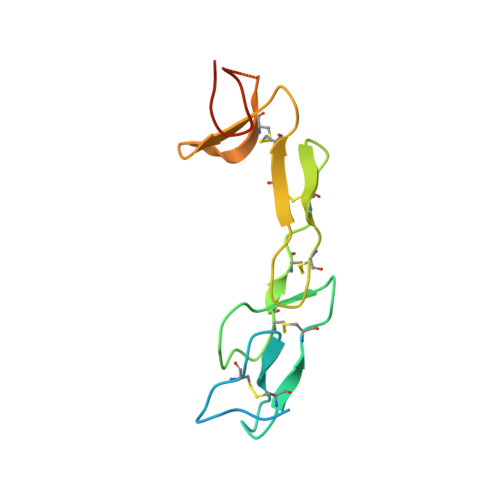
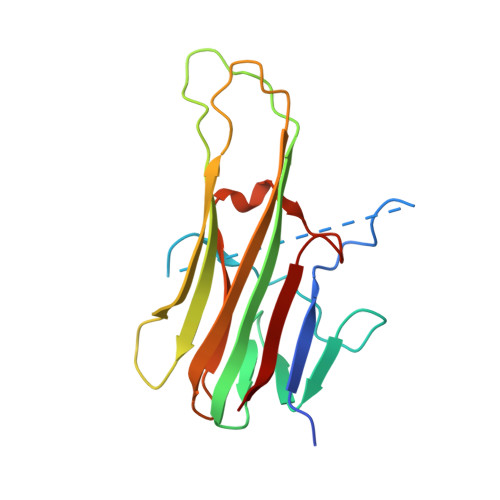
Crystal structure of TRAIL-SDR5


Experimental Data Snapshot

  • Method: X-RAY DIFFRACTION
  • Resolution: 2.20 Å
  • R-Value Free: 
    0.291 (Depositor) 
  • R-Value Work: 
    0.291 (Depositor) 
  • R-Value Observed: 
    0.212 (Depositor) 

wwPDB Validation 3D Report Full Report

Validation slider image for 1DU3

This is version 1.4 of the entry. See complete history

Literature

Crystal structure of TRAIL-DR5 complex identifies a critical role of the unique frame insertion in conferring recognition specificity

Cha, S.-S.Sung, B.-J.Kim, Y.A.Song, Y.L.Kim, H.J.Kim, S.Lee, M.S.Oh, B.-H.

(2000) J Biological Chem 275: 31171-31177

  • DOI: https://doi.org/10.1074/jbc.M004414200
  • Primary Citation Related Structures: 
    1DU3

  • PubMed Abstract: 

    TRAIL is a cytokine that induces apoptosis in a wide variety of tumor cells but rarely in normal cells. It contains an extraordinarily elongated loop because of an unique insertion of 12-16 amino acids compared with the other members of tumor necrosis factor family. Biological implication of the frame insertion has not been clarified. We have determined the crystal structure of TRAIL in a complex with the extracellular domain of death receptor DR5 at 2.2 A resolution. The structure reveals extensive contacts between the elongated loop and DR5 in an interaction mode that would not be allowed without the frame insertion. These interactions are missing in the structures of the complex determined by others recently. This observation, along with structure-inspired deletion analysis, identifies the critical role of the frame insertion as a molecular strategy conferring specificity upon the recognition of cognate receptors. The structure also suggests that a built-in flexibility of the tumor necrosis factor receptor family members is likely to play a general and important role in the binding and recognition of tumor necrosis factor family members.


  • Organizational Affiliation
    • Department of Life Science, and Division of Molecular and Life Science, Pohang University of Science and Technology, Pohang, Kyungbuk, 790-784, Korea.

Macromolecule Content 

  • Total Structure Weight: 204.73 kDa 
  • Atom Count: 12,108 
  • Modeled Residue Count: 1,490 
  • Deposited Residue Count: 1,788 
  • Unique protein chains: 2

Macromolecules

Find similar proteins by:|  3D Structure
Entity ID: 1
MoleculeChains  Sequence LengthOrganismDetailsImage
DEATH RECEPTOR 5
A, B, C, G, H
A, B, C, G, H, I
130Homo sapiensMutation(s): 0 
UniProt & NIH Common Fund Data Resources
Find proteins for O14763 (Homo sapiens)
Explore O14763 
Go to UniProtKB:  O14763
PHAROS:  O14763
GTEx:  ENSG00000120889 
Entity Groups
Sequence Clusters30% Identity50% Identity70% Identity90% Identity95% Identity100% Identity
UniProt GroupO14763
Sequence Annotations
Expand
Reference Sequence
Find similar proteins by:|  3D Structure
Entity ID: 2
MoleculeChains  Sequence LengthOrganismDetailsImage
TNF-RELATED APOPTOSIS INDUCING LIGAND
D, E, F, J, K
D, E, F, J, K, L
168Homo sapiensMutation(s): 0 
UniProt & NIH Common Fund Data Resources
Find proteins for P50591 (Homo sapiens)
Explore P50591 
Go to UniProtKB:  P50591
PHAROS:  P50591
GTEx:  ENSG00000121858 
Entity Groups
Sequence Clusters30% Identity50% Identity70% Identity90% Identity95% Identity100% Identity
UniProt GroupP50591
Sequence Annotations
Expand
Reference Sequence

Small Molecules

Experimental Data & Validation

Experimental Data

  • Method: X-RAY DIFFRACTION
  • Resolution: 2.20 Å
  • R-Value Free:  0.291 (Depositor) 
  • R-Value Work:  0.291 (Depositor) 
  • R-Value Observed: 0.212 (Depositor) 
Space Group: P 1 21 1
Unit Cell:
Length ( Å )Angle ( ˚ )
a = 68.63α = 90
b = 124.81β = 104.489
c = 128.37γ = 90
Software Package:
Software NamePurpose
DENZOdata reduction
SCALEPACKdata scaling
AMoREphasing
X-PLORrefinement

Structure Validation

View Full Validation Report


Entry History 

Deposition Data

Revision History  (Full details and data files)

  • Version 1.0: 2000-09-27
    Type: Initial release
  • Version 1.1: 2008-04-27
    Changes: Version format compliance
  • Version 1.2: 2011-07-13
    Changes: Version format compliance
  • Version 1.3: 2018-01-31
    Changes: Experimental preparation
  • Version 1.4: 2024-11-06
    Changes: Data collection, Database references, Derived calculations, Structure summary