Download Mendeley
Conformational changes induced by phosphorylation of the FixJ receiver domain.
Birck, C., Mourey, L., Gouet, P., Fabry, B., Schumacher, J., Rousseau, P., Kahn, D., Samama, J.P.(1999) Structure 7: 1505-1515
- PubMed: 10647181 Search on PubMed
- DOI: https://doi.org/10.1016/s0969-2126(00)88341-0
- Primary Citation Related Structures:
1D5W - PubMed Abstract:
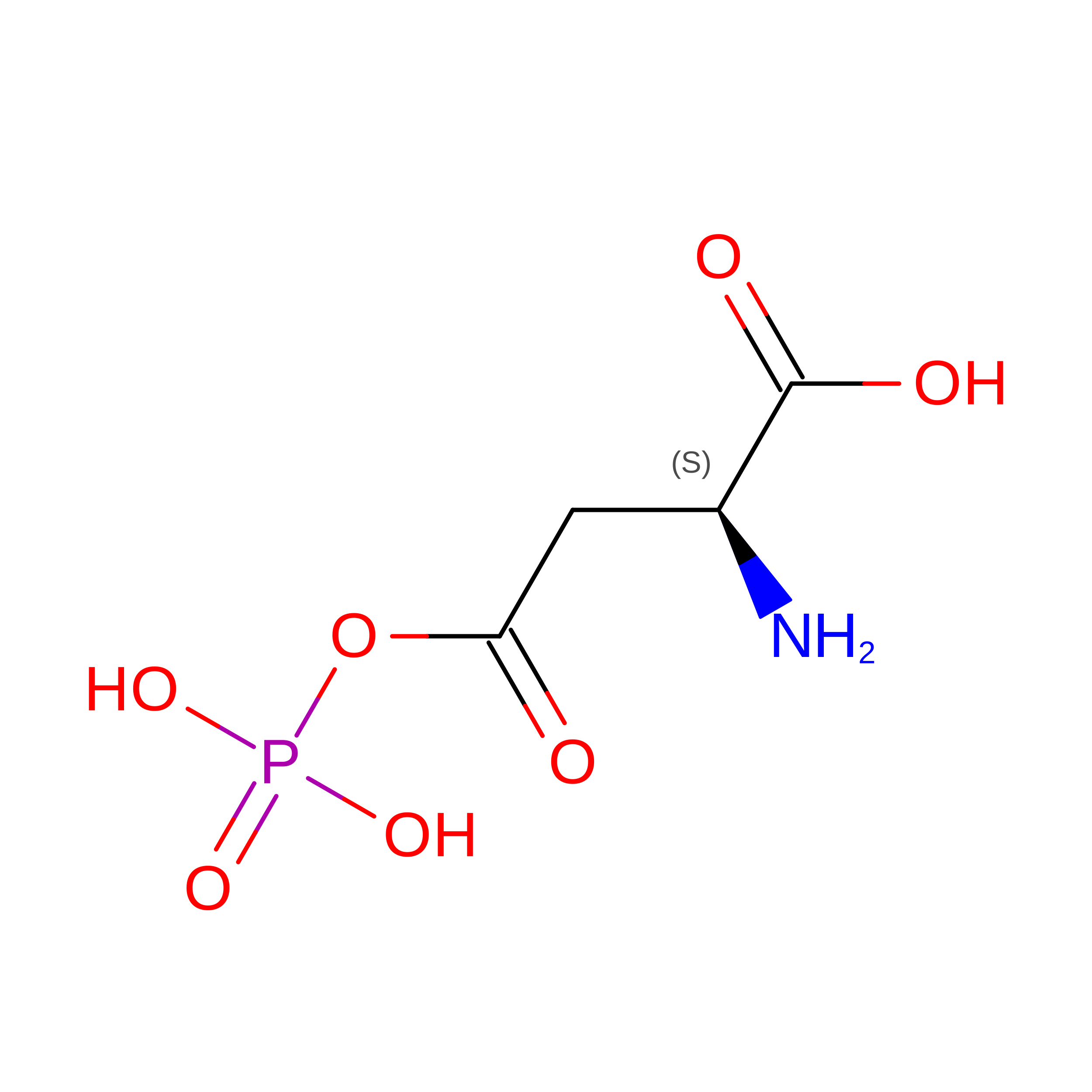
A variety of bacterial adaptative cellular responses to environmental stimuli are mediated by two-component signal transduction pathways. In these phosphorelay cascades, histidine kinases transphosphorylate a conserved aspartate in the receiver domain, a conserved module in the response regulator superfamily. The main effect of this phosphorylation is to alter the conformation of the response regulator in order to modulate its biological function. The response regulator FixJ displays a typical modular arrangement, with a phosphorylatable N-terminal receiver domain and a C-terminal DNA-binding domain. In the symbiotic bacterium Sinorhizobium meliloti, phosphorylation of this response regulator activates transcription of nitrogen-fixation genes. The crystal structures of the phosphorylated and of the unphosphorylated N-terminal receiver domain of FixJ (FixJN) were solved at 2.3 A and 2.4 A resolution, respectively. They reveal the environment of the phosphoaspartate in the active site and the specific conformational changes leading to activation of the response regulator. Phosphorylation of the conserved aspartate induces major structural changes in the beta 4-alpha 4 loop, and in the signaling surface alpha 4-beta 5 that mediates dimerization of the phosphorylated full-length response regulator. A site-directed mutant at this protein-protein interface decreases the affinity of the phosphorylated response regulator for the fixK promoter tenfold. The cascade of phosphorylation-induced conformational changes in FixJN illustrates the role of conserved residues in stabilizing the phosphoryl group in the active site, triggering the structural transition and achieving the post-phosphorylation signaling events. We propose that these phosphorylation-induced conformational changes underly the activation of response regulators in general.
- Groupe de Cristallographie Biologique, CNRS-IPBS, Toulouse, France.
Organizational Affiliation: