Download Mendeley
Structure of the pure-spermine form of Z-DNA (magnesium free) at 1-A resolution.
Egli, M., Williams, L.D., Gao, Q., Rich, A.(1991) Biochemistry 30: 11388-11402
- PubMed: 1742278 Search on PubMed
- DOI: https://doi.org/10.1021/bi00112a005
- Primary Citation Related Structures:
1D48 - PubMed Abstract:
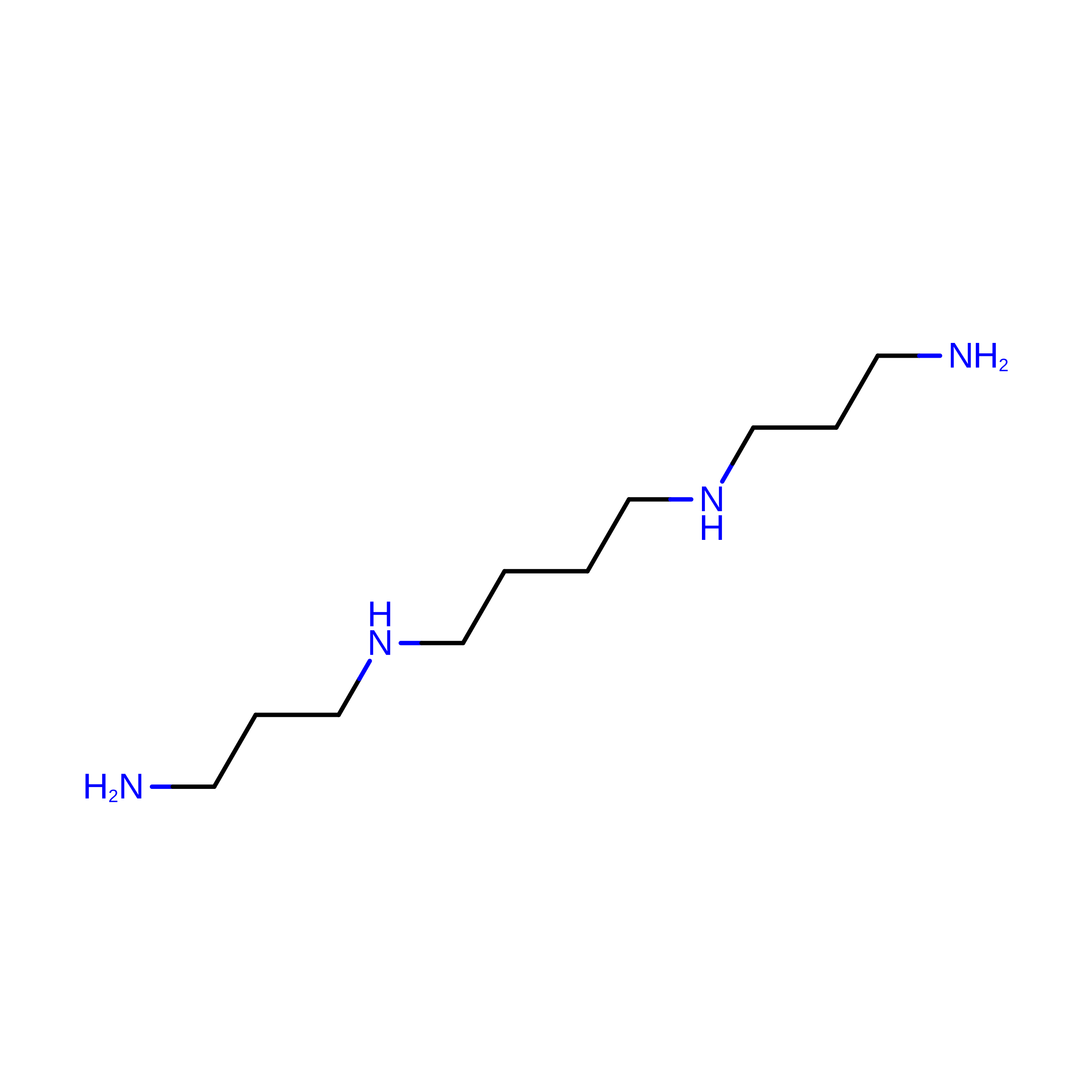
We describe the three-dimensional X-ray structure of a complex of spermine bound to a Z-DNA duplex, [d(CGCGCG)]2, in the absence of any inorganic polyvalent cations. We have crystallized the DNA hexamer d(CGCGCG) in the exclusion of magnesium and other polyvalent ions and solved its structure at 1.0-A resolution. In the crystal of this pure-spermine form of Z-DNA, the relative orientation, position, and interactions of the DNA differ from the arrangement uniformly observed in over a dozen previously reported Z-DNA hexamers. Moreover, the conformation of the Z-DNA hexamer in this structure varies somewhat from those found in earlier structures. The DNA is compressed along the helical axis, the base pairs are shifted into the major groove, and the minor groove is more narrow. The packing of spermine-DNA complexes in crystals suggests that the molecular basis for the tendency of spermine to stabilize compact DNA structures derives from the capacity of spermine to interact simultaneously with several duplexes. This capacity is maximized by both the polymorphic nature and the length of the spermine cation. The length and flexibility of spermine and the dispersion of charge-charge, hydrogen-bonding, and hydrophobic bonding potential throughout the molecule maximize the ability of spermine to interact simultaneously with different DNA molecules.
- Department of Biology, Massachusetts Institute of Technology, Cambridge 02139.
Organizational Affiliation: