Download Mendeley
Comparisons of wild-type and mutant flavodoxins from Anacystis nidulans. Structural determinants of the redox potentials.
Hoover, D.M., Drennan, C.L., Metzger, A.L., Osborne, C., Weber, C.H., Pattridge, K.A., Ludwig, M.L.(1999) J Mol Biol 294: 725-743
- PubMed: 10610792 Search on PubMed
- DOI: https://doi.org/10.1006/jmbi.1999.3152
- Primary Citation Related Structures:
1CZH, 1CZK, 1CZL, 1CZO, 1CZR, 1D04 - PubMed Abstract:
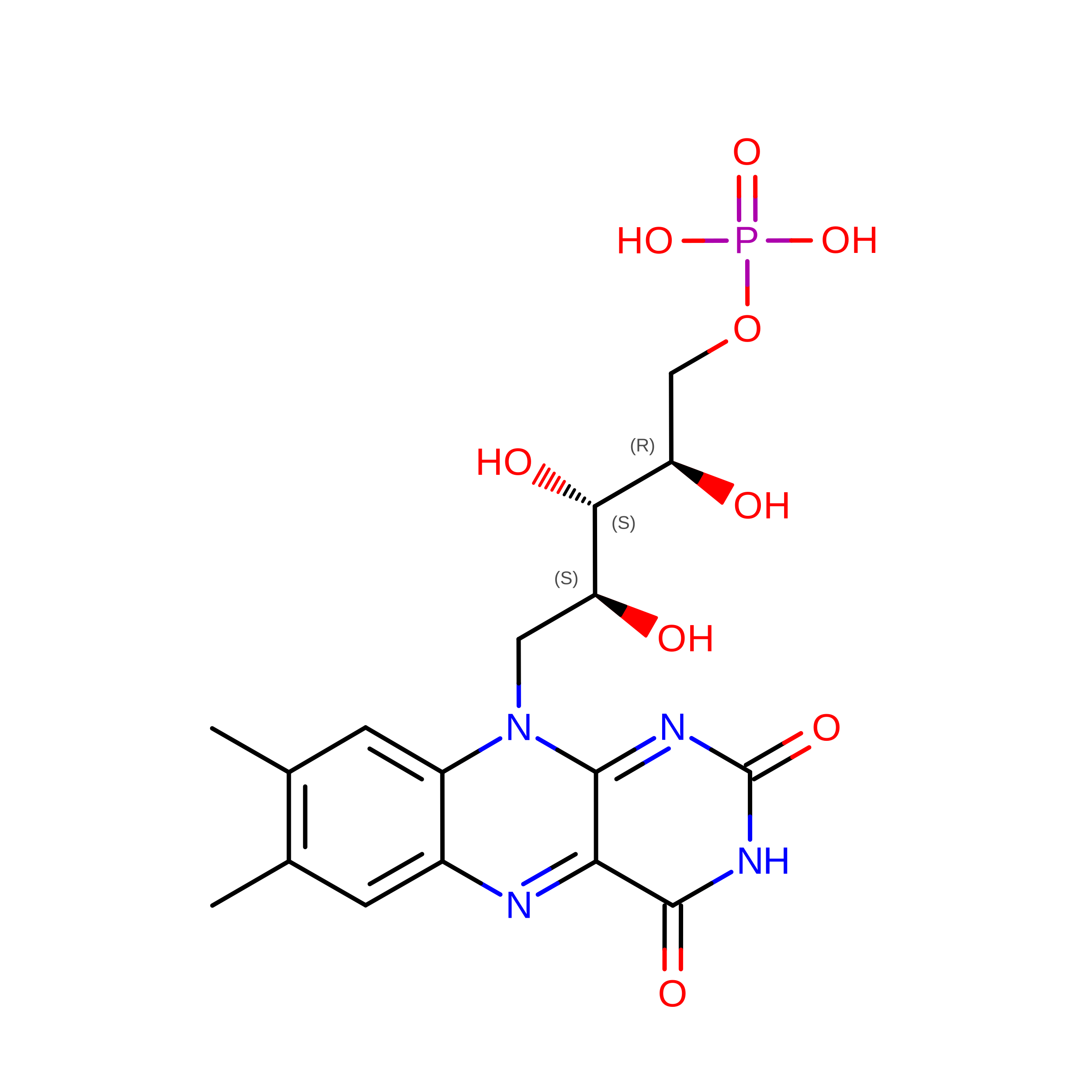
The long-chain flavodoxins, with 169-176 residues, display oxidation-reduction potentials at pH 7 that vary from -50 to -260 mV for the oxidized/semiquinone (ox/sq) equilibrium and are -400 mV or lower for the semiquinone/hydroquinone (sq/hq) equilibrium. To examine the effects of protein interactions and conformation changes on FMN potentials in the long-chain flavodoxin from Anacystis nidulans (Synechococcus PCC 7942), we have determined crystal structures for the semiquinone and hydroquinone forms of the wild-type protein and for the mutant Asn58Gly, and have measured redox potentials and FMN association constants. A peptide near the flavin ring, Asn58-Val59, reorients when the FMN is reduced to the semiquinone form and adopts a conformation ("O-up") in which O 58 hydrogen bonds to the flavin N(5)H; this rearrangement is analogous to changes observed in the flavodoxins from Clostridium beijerinckii and Desulfovibrio vulgaris. On further reduction to the hydroquinone state, the Asn58-Val59 peptide in crystalline wild-type A. nidulans flavodoxin rotates away from the flavin to the "O-down" position characteristic of the oxidized structure. This reversion to the conformation found in the oxidized state is unusual and has not been observed in other flavodoxins. The Asn58Gly mutation, at the site which undergoes conformation changes when FMN is reduced, was expected to stabilize the O-up conformation found in the semiquinone oxidation state. This mutation raises the ox/sq potential by 46 mV to -175 mV and lowers the sq/hq potential by 26 mV to -468 mV. In the hydroquinone form of the Asn58Gly mutant the C-O 58 remains up and hydrogen bonded to N(5)H, as in the fully reduced flavodoxins from C. beijerinckii and D. vulgaris. The redox and structural properties of A. nidulans flavodoxin and the Asn58Gly mutant confirm the importance of interactions made by N(5) or N(5)H in determining potentials, and are consistent with earlier conclusions that conformational energies contribute to the observed potentials.The mutations Asp90Asn and Asp100Asn were designed to probe the effects of electrostatic interactions on the potentials of protein-bound flavin. Replacement of acidic by neutral residues at positions 90 and 100 does not perturb the structure, but has a substantial effect on the sq/hq equilibrium. This potential is increased by 25-41 mV, showing that electrostatic interaction between acidic residues and the flavin decreases the potential for conversion of the neutral semiquinone to the anionic hydroquinone. The potentials and the effects of mutations in A. nidulans flavodoxin are rationalized using a thermodynamic scheme developed for C. beijerinckii flavodoxin.
- Biophysics Research Division and Department of Biological Chemistry, University of Michigan, 930 N. Univeristy Ave., Ann Arbor, MI 48109, USA.
Organizational Affiliation: