Download Mendeley
Ab initio solution and refinement of two high-potential iron protein structures at atomic resolution.
Parisini, E., Capozzi, F., Lubini, P., Lamzin, V., Luchinat, C., Sheldrick, G.M.(1999) Acta Crystallogr D Biol Crystallogr 55: 1773-1784
- PubMed: 10531472 Search on PubMed
- DOI: https://doi.org/10.1107/s0907444999009129
- Primary Citation Related Structures:
1B0Y, 1CKU - PubMed Abstract:
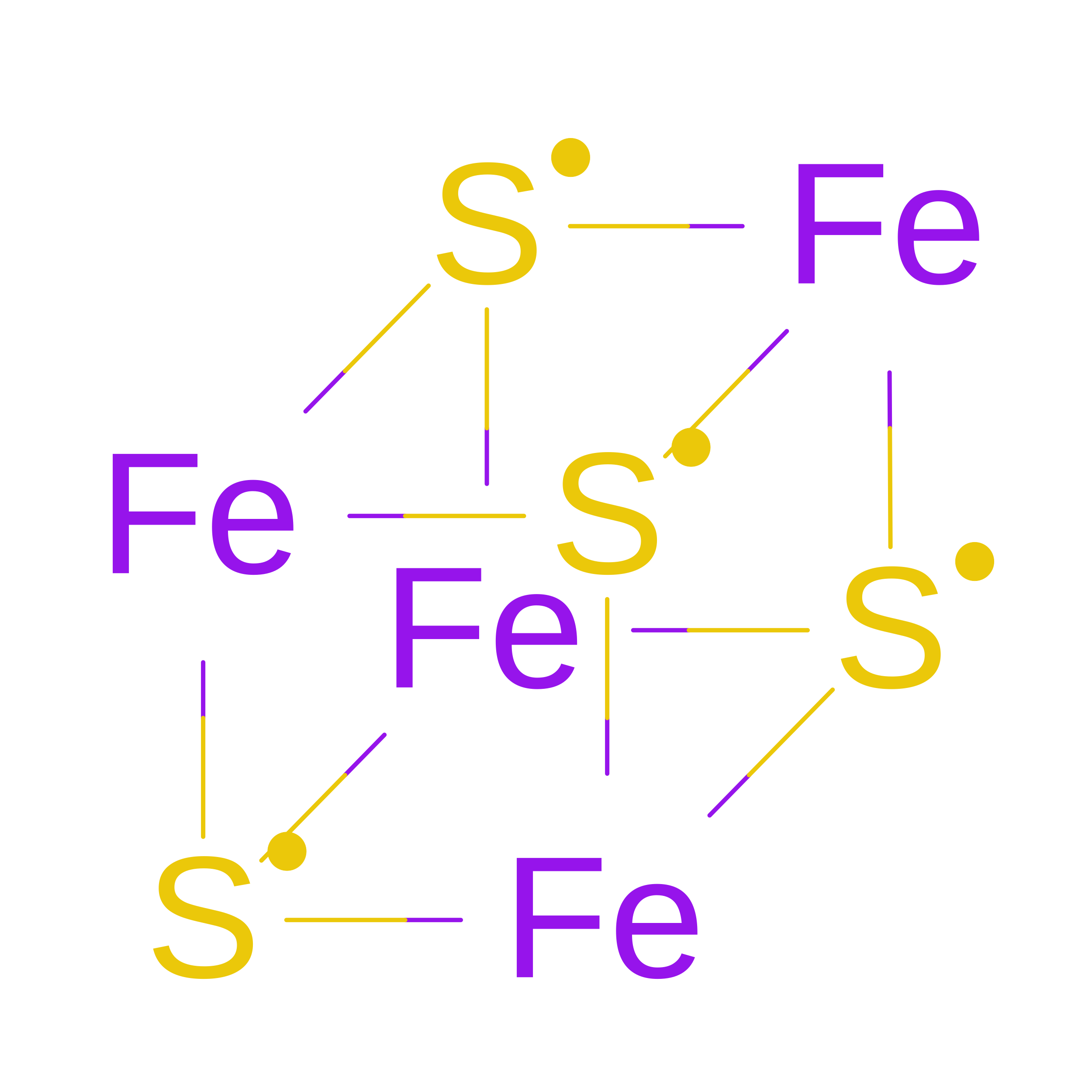
The crystal structure of the reduced high-potential iron protein (HiPIP) from Chromatium vinosum has been redetermined in a new orthorhombic crystal modification, and the structure of its H42Q mutant has been determined in orthorhombic (H42Q-1) and cubic (H42Q-2) modifications. The first two were solved by ab initio direct methods using data collected to atomic resolution (1.20 and 0. 93 A, respectively). The recombinant wild type (rc-WT) with two HiPIP molecules in the asymmetric unit has 1264 protein atoms and 335 solvent sites, and is the second largest structure reported so far that has been solved by pure direct methods. The solutions were obtained in a fully automated way and included more than 80% of the protein atoms. Restrained anisotropic refinement for rc-WT and H42Q-1 converged to R(1) = summation operator||F(o)| - |F(c)|| / summation operator|F(o)| of 12.0 and 13.6%, respectively [data with I > 2sigma(I)], and 12.8 and 15.5% (all data). H42Q-2 contains two molecules in the asymmetric unit and diffracted only to 2.6 A. In both molecules of rc-WT and in the single unique molecule of H42Q-1 the [Fe(4)S(4)](2+) cluster dimensions are very similar and show a characteristic tetragonal distortion with four short Fe-S bonds along four approximately parallel cube edges, and eight long Fe-S bonds. The unique protein molecules in H42Q-2 and rc-WT are also very similar in other respects, except for the hydrogen bonding around the mutated residue that is at the surface of the protein, supporting the hypothesis that the difference in redox potentials at lower pH values is caused primarily by differences in the charge distribution near the surface of the protein rather than by structural differences in the cluster region.
- Institut für Anorganische Chemie, University of Göttingen, Tammannstrasse 4, D-37077, Göttingen, Germany.
Organizational Affiliation: