1CI4 | pdb_00001ci4

THE CRYSTAL STRUCTURE OF HUMAN BARRIER-TO-AUTOINTEGRATION FACTOR (BAF)


Experimental Data Snapshot

  • Method: X-RAY DIFFRACTION
  • Resolution: 1.90 Å
  • R-Value Free: 
    0.262 (Depositor), 0.263 (DCC) 
  • R-Value Work: 
    0.210 (Depositor), 0.210 (DCC) 

wwPDB Validation 3D Report Full Report

Validation slider image for 1CI4

This is version 2.2 of the entry. See complete history

Literature

Structural basis of DNA bridging by barrier-to-autointegration factor.

Umland, T.C.Wei, S.Q.Craigie, R.Davies, D.R.

(2000) Biochemistry 39: 9130-9138

  • DOI: https://doi.org/10.1021/bi000572w
  • Primary Citation Related Structures: 
    1CI4

  • PubMed Abstract: 

    Barrier-to-autointegration factor (BAF) is a host cell protein that plays a crucial role in retroviral integration. Preintegration complexes (PICs) stripped of BAF lose their normal integration activity, which can be restored by incubation with purified BAF. BAF bridges double-stranded DNA both intra- and intermolecularly in a non-sequence-specific manner, leading to the formation of a nucleoprotein network. BAF also binds to the nuclear protein lamina-associated polypeptide 2 (LAP2), and is localized with chromatin during interphase and mitosis. The crystal structure of homodimeric human BAF has been determined to 1.9 A resolution. The fold of the BAF monomer resembles that of the second domain of RuvA. This comparison revealed the presence of the helix-hairpin-helix (HhH) nonspecific DNA binding motif within BAF. A novel feature of BAF's HhH motif is the occupation of the metal binding site by the epsilon-amino group of Lys 6, providing an alternative means of sequestering positive charge. Mutational analysis corroborates the HhH motif's prominent role in DNA binding and argues against a previously proposed helix-turn-helix (HTH) binding site located in another region of the monomer. A model of BAF bridging DNA via the HhH motif is proposed.


  • Organizational Affiliation
    • Laboratory of Molecular Biology, National Institute of Diabetes and Digestive and Kidney Diseases, National Institutes of Health, Bethesda, MD 20892, USA.

Macromolecule Content 

  • Total Structure Weight: 20.33 kDa 
  • Atom Count: 1,617 
  • Modeled Residue Count: 177 
  • Deposited Residue Count: 178 
  • Unique protein chains: 1

Macromolecules

Find similar proteins by:|  3D Structure
Entity ID: 1
MoleculeChains  Sequence LengthOrganismDetailsImage
PROTEIN (BARRIER-TO-AUTOINTEGRATION FACTOR (BAF))
A, B
89Homo sapiensMutation(s): 2 
UniProt & NIH Common Fund Data Resources
Find proteins for O75531 (Homo sapiens)
Explore O75531 
Go to UniProtKB:  O75531
PHAROS:  O75531
GTEx:  ENSG00000175334 
Entity Groups
Sequence Clusters30% Identity50% Identity70% Identity90% Identity95% Identity100% Identity
UniProt GroupO75531
Sequence Annotations
Expand
Reference Sequence

Small Molecules

Modified Residues  1 Unique
IDChains TypeFormula2D DiagramParent
MSE
Query on MSE
A, B
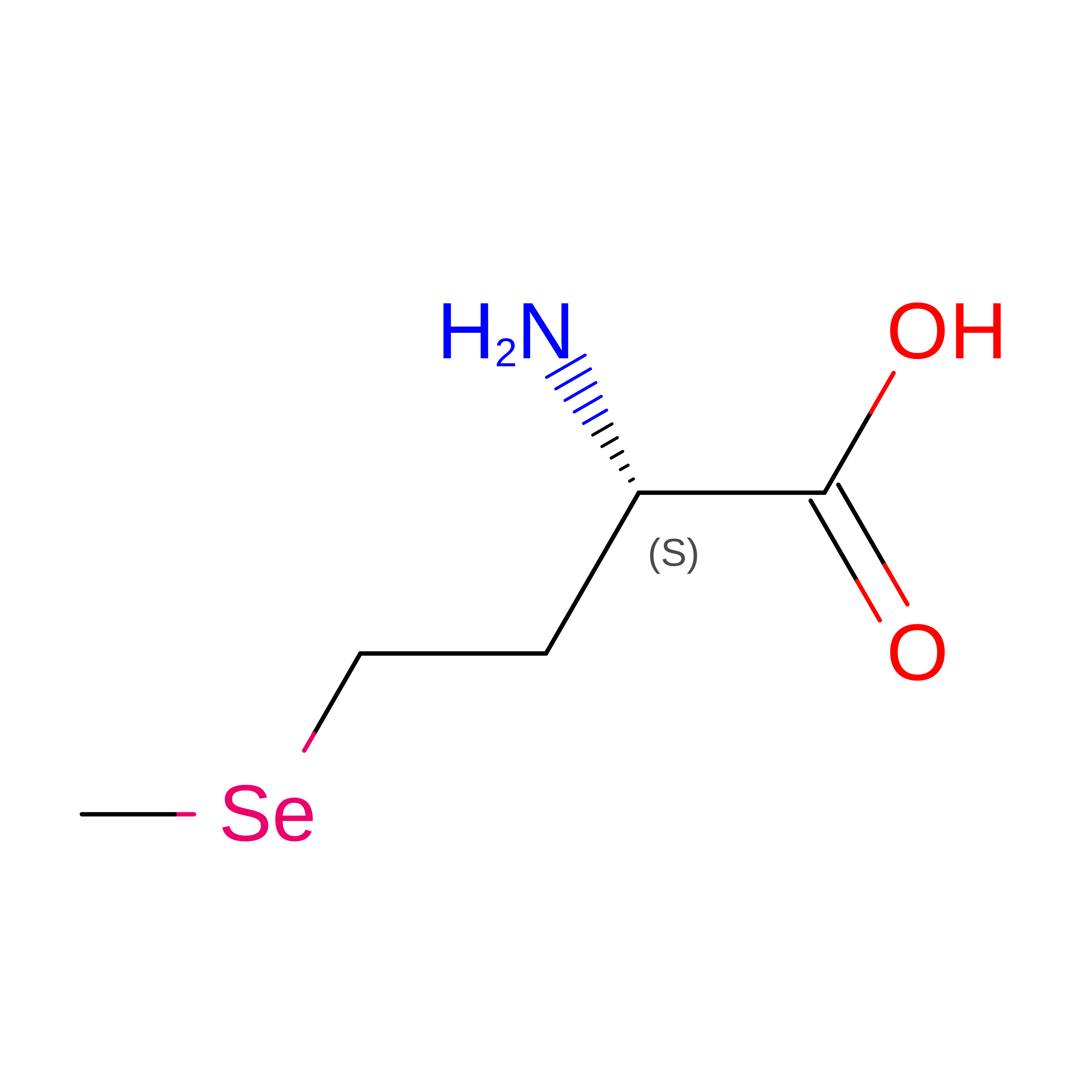
L-PEPTIDE LINKINGC5 H11 N O2 SeMET

Experimental Data & Validation

Experimental Data

  • Method: X-RAY DIFFRACTION
  • Resolution: 1.90 Å
  • R-Value Free:  0.262 (Depositor), 0.263 (DCC) 
  • R-Value Work:  0.210 (Depositor), 0.210 (DCC) 
Space Group: P 43 21 2
Unit Cell:
Length ( Å )Angle ( ˚ )
a = 41.8α = 90
b = 41.8β = 90
c = 214.6γ = 90
Software Package:
Software NamePurpose
SOLVEphasing
PHASES-95model building
CNSrefinement
DENZOdata reduction
SCALEPACKdata scaling
PHASESphasing

Structure Validation

View Full Validation Report


Entry History 

Deposition Data

Revision History  (Full details and data files)

  • Version 1.0: 2000-08-16
    Type: Initial release
  • Version 1.1: 2008-04-26
    Changes: Version format compliance
  • Version 1.2: 2011-07-13
    Changes: Version format compliance
  • Version 2.0: 2019-11-27
    Changes: Atomic model, Database references, Derived calculations
  • Version 2.1: 2023-12-27
    Changes: Advisory, Data collection, Database references, Derived calculations
  • Version 2.2: 2024-10-30
    Changes: Structure summary