1A6L | pdb_00001a6l

T14C MUTANT OF AZOTOBACTER VINELANDII FDI


Experimental Data Snapshot

  • Method: X-RAY DIFFRACTION
  • Resolution: 2.10 Å
  • R-Value Work: 
    0.206 (Depositor) 
  • R-Value Observed: 
    0.206 (Depositor) 

Starting Model: experimental
View more details

wwPDB Validation 3D Report Full Report

Validation slider image for 1A6L

This is version 1.5 of the entry. See complete history

Literature

A T14C variant of Azotobacter vinelandii ferredoxin I undergoes facile [3Fe-4S]0 to [4Fe-4S]2+ conversion in vitro but not in vivo.

Gao-Sheridan, H.S.Kemper, M.A.Khayat, R.Tilley, G.J.Armstrong, F.A.Sridhar, V.Prasad, G.S.Stout, C.D.Burgess, B.K.

(1998) J Biological Chem 273: 33692-33701

  • DOI: https://doi.org/10.1074/jbc.273.50.33692
  • Primary Citation Related Structures: 
    1A6L

  • PubMed Abstract: 

    [4Fe-4S]2+/+ clusters that are ligated by Cys-X-X-Cys-X-X-Cys sequence motifs share the general feature of being hard to convert to [3Fe-4S]+/0 clusters, whereas those that contain a Cys-X-X-Asp-X-X-Cys motif undergo facile and reversible cluster interconversion. Little is known about the factors that control the in vivo assembly and conversion of these clusters. In this study we have designed and constructed a 3Fe to 4Fe cluster conversion variant of Azotobacter vinelandii ferredoxin I (FdI) in which the sequence that ligates the [3Fe-4S] cluster in native FdI was altered by converting a nearby residue, Thr-14, to Cys. Spectroscopic and electrochemical characterization shows that when purified in the presence of dithionite, T14C FdI is an O2-sensitive 8Fe protein. Both the new and the indigenous clusters have reduction potentials that are significantly shifted compared with those in native FdI, strongly suggesting a significantly altered environment around the clusters. Interestingly, whole cell EPR have revealed that T14C FdI exists as a 7Fe protein in vivo. This 7Fe form of T14C FdI is extremely similar to native FdI in its spectroscopic, electrochemical, and structural features. However, unlike native FdI which does not undergo facile cluster conversion, the 7Fe form T14C FdI quickly converts to the 8Fe form with a high efficiency under reducing conditions.


  • Organizational Affiliation
    • Department of Molecular Biology and Biochemistry, University of California, Irvine, California 92697-3900, USA.

Macromolecule Content 

  • Total Structure Weight: 12.71 kDa 
  • Atom Count: 903 
  • Modeled Residue Count: 106 
  • Deposited Residue Count: 106 
  • Unique protein chains: 1

Macromolecules

Find similar proteins by:|  3D Structure
Entity ID: 1
MoleculeChains  Sequence LengthOrganismDetailsImage
FERREDOXIN106Azotobacter vinelandiiMutation(s): 1 
UniProt
Find proteins for P00214 (Azotobacter vinelandii)
Explore P00214 
Go to UniProtKB:  P00214
Entity Groups
Sequence Clusters30% Identity50% Identity70% Identity90% Identity95% Identity100% Identity
UniProt GroupP00214
Sequence Annotations
Expand
Reference Sequence

Small Molecules

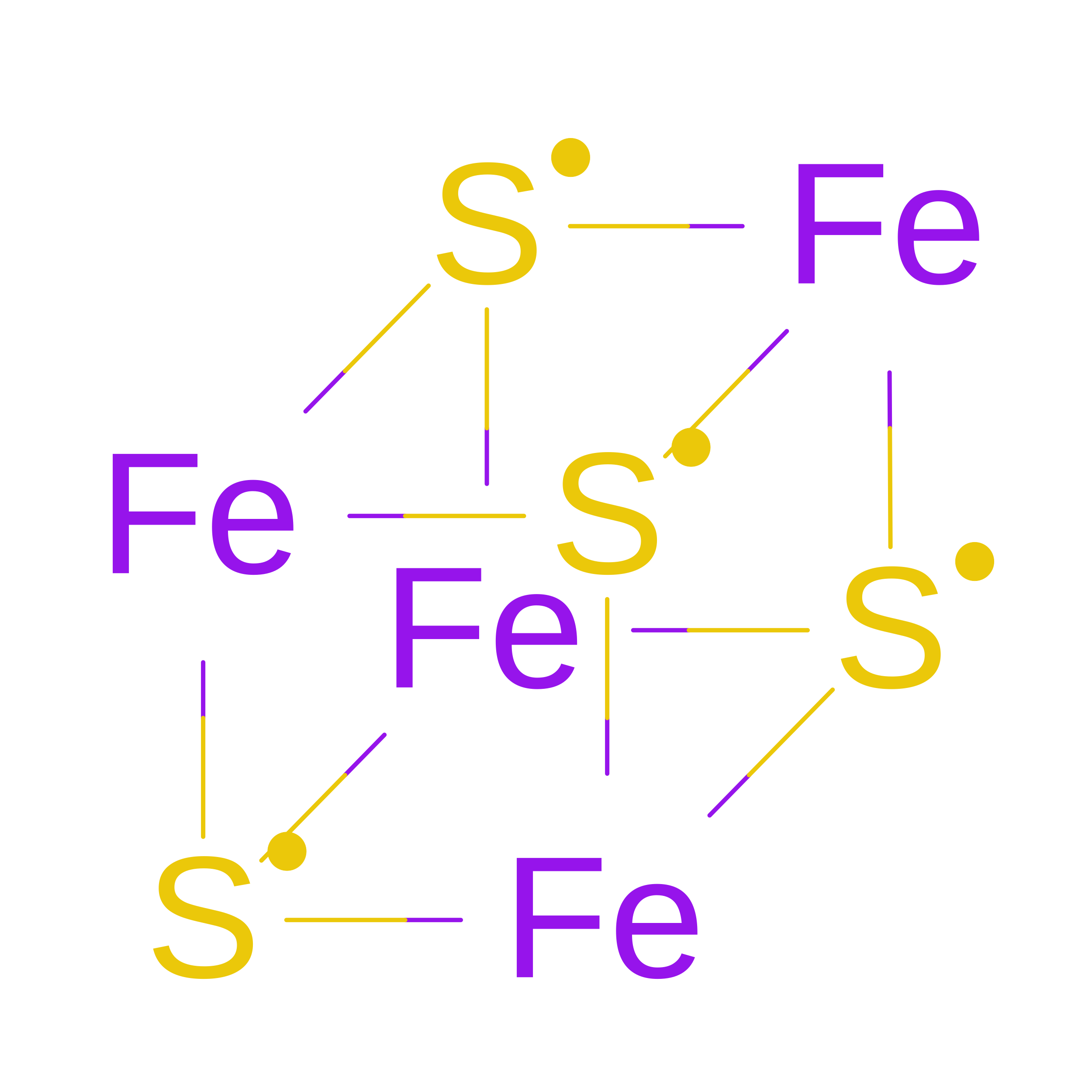
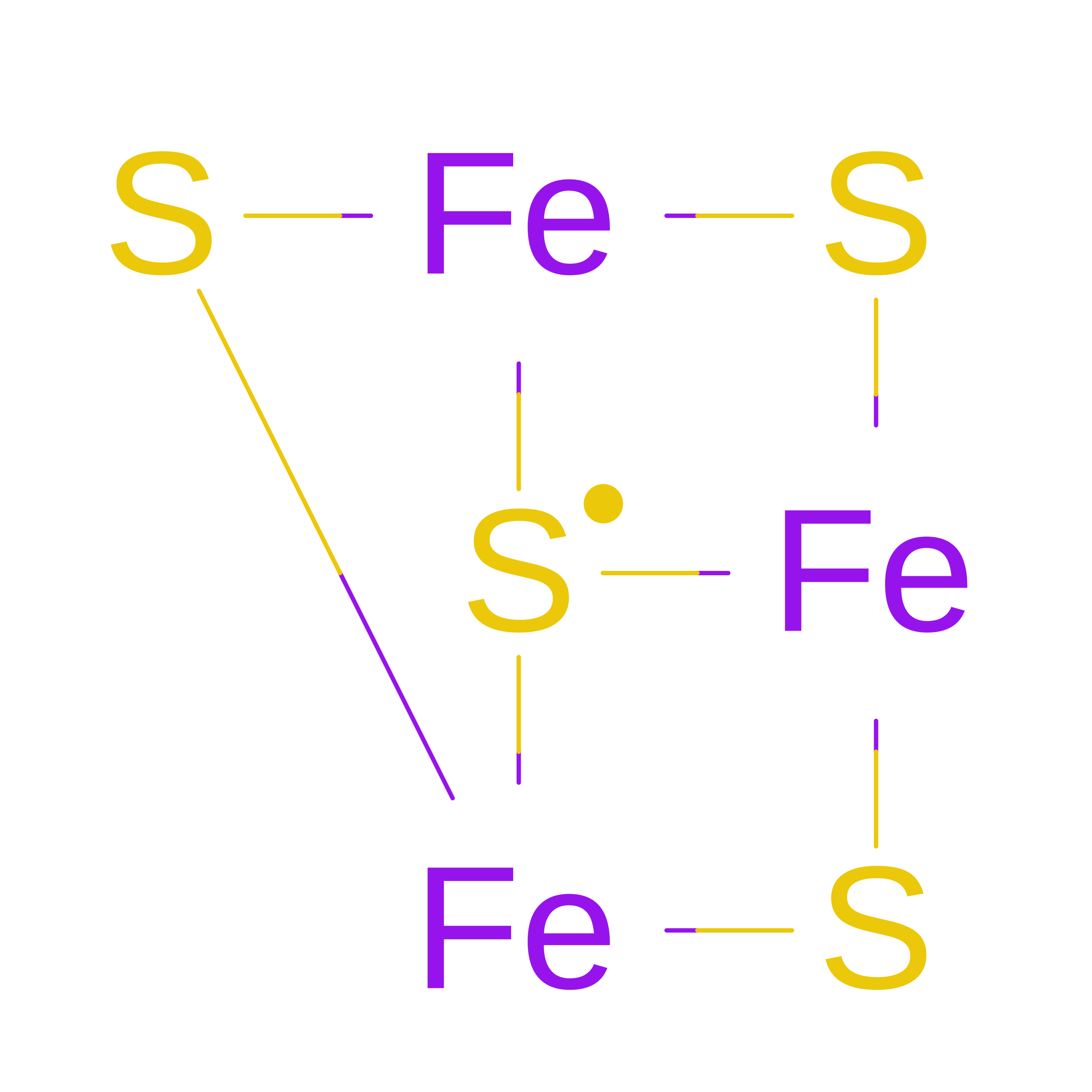
Ligands 2 Unique
IDChains Name / Formula / InChI Key2D Diagram3D Interactions
SF4

Query on SF4


Download:Ideal Coordinates CCD File
B [auth A]IRON/SULFUR CLUSTER
Fe4 S4
LJBDFODJNLIPKO-UHFFFAOYSA-N
F3S

Query on F3S


Download:Ideal Coordinates CCD File
C [auth A]FE3-S4 CLUSTER
Fe3 S4
FCXHZBQOKRZXKS-UHFFFAOYSA-N

Experimental Data & Validation

Experimental Data

  • Method: X-RAY DIFFRACTION
  • Resolution: 2.10 Å
  • R-Value Work:  0.206 (Depositor) 
  • R-Value Observed: 0.206 (Depositor) 
Space Group: P 41 21 2
Unit Cell:
Length ( Å )Angle ( ˚ )
a = 55.88α = 90
b = 55.88β = 90
c = 96.4γ = 90
Software Package:
Software NamePurpose
X-PLORmodel building
X-PLORrefinement
XENGENdata reduction
XENGENdata scaling
X-PLORphasing

Structure Validation

View Full Validation Report


Entry History 

Deposition Data

Revision History  (Full details and data files)

  • Version 1.0: 1998-05-27
    Type: Initial release
  • Version 1.1: 2008-03-28
    Changes: Version format compliance
  • Version 1.2: 2011-07-13
    Changes: Version format compliance
  • Version 1.3: 2021-11-03
    Changes: Database references, Derived calculations, Other
  • Version 1.4: 2023-08-02
    Changes: Refinement description
  • Version 1.5: 2024-05-22
    Changes: Data collection