1A05 | pdb_00001a05

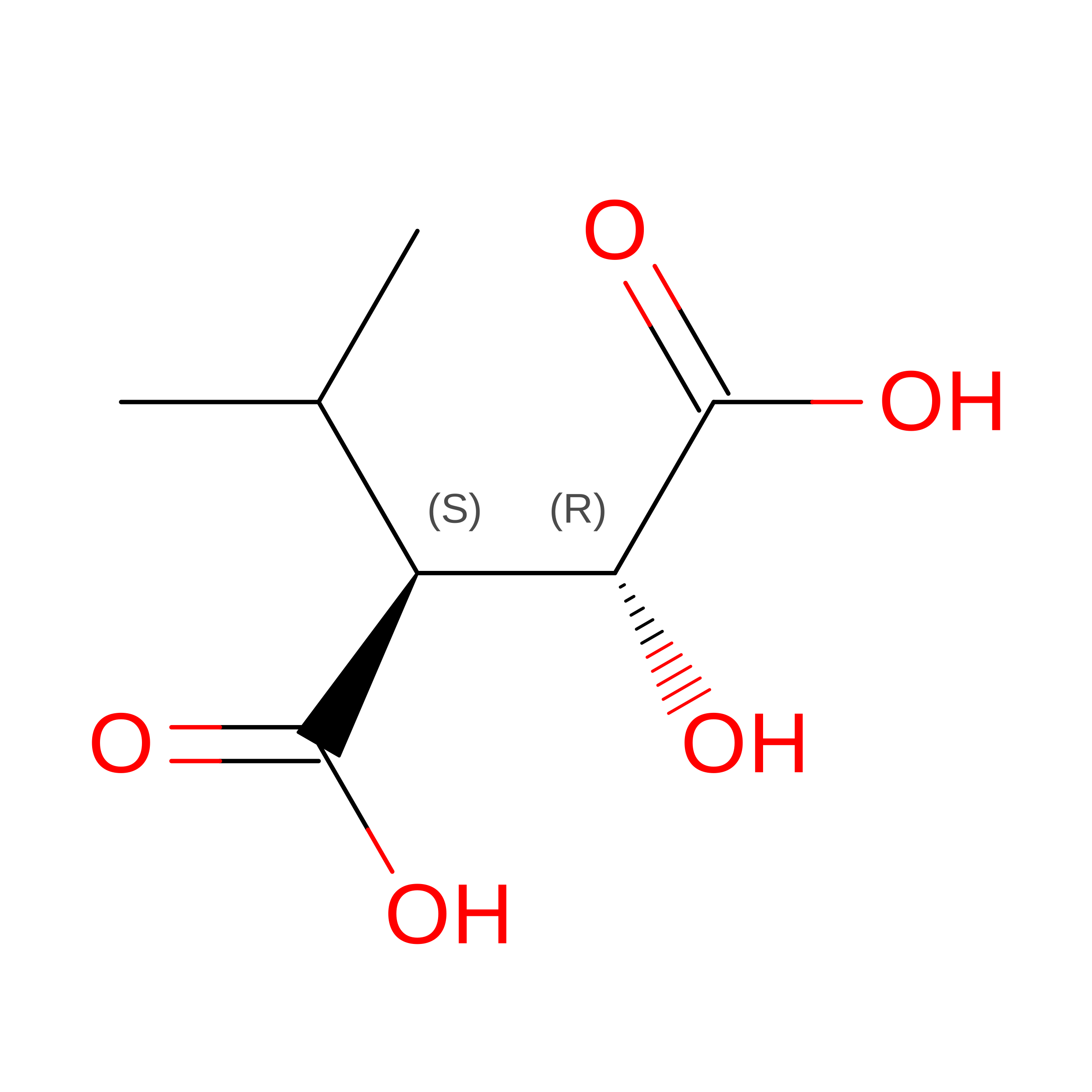
CRYSTAL STRUCTURE OF THE COMPLEX OF 3-ISOPROPYLMALATE DEHYDROGENASE FROM THIOBACILLUS FERROOXIDANS WITH 3-ISOPROPYLMALATE


Experimental Data Snapshot

  • Method: X-RAY DIFFRACTION
  • Resolution: 2.00 Å
  • R-Value Free: 
    0.275 (Depositor), 0.252 (DCC) 
  • R-Value Work: 
    0.198 (Depositor), 0.188 (DCC) 
  • R-Value Observed: 
    0.198 (Depositor) 

Starting Model: experimental
View more details

wwPDB Validation 3D Report Full Report

Validation slider image for 1A05

Ligand Structure Quality Assessment 


This is version 1.4 of the entry. See complete history

Literature

Structure of 3-isopropylmalate dehydrogenase in complex with 3-isopropylmalate at 2.0 A resolution: the role of Glu88 in the unique substrate-recognition mechanism.

Imada, K.Inagaki, K.Matsunami, H.Kawaguchi, H.Tanaka, H.Tanaka, N.Namba, K.

(1998) Structure 6: 971-982

  • DOI: https://doi.org/10.1016/s0969-2126(98)00099-9
  • Primary Citation Related Structures: 
    1A05

  • PubMed Abstract: 

    3-Isopropylmalate dehydrogenase (IPMDH) and isocitrate dehydrogenase (ICDH) belong to a unique family of bifunctional decarboxylating dehydrogenases. Although the ICDH dimer catalyzes its reaction under a closed conformation, known structures of the IPMDH dimer (without substrate) adopt a fully open or a partially closed form. Considering the similarity in the catalytic mechanism, the IPMDH dimer must be in a fully closed conformation during the reaction. A large conformational change should therefore occur upon substrate binding. We have determined the crystal structure of IPMDH from Thiobacillus ferrooxidans (Tf) complexed with 3-isopropylmalate (IPM) at 2.0 A resolution by the molecular replacement method. The structure shows a fully closed conformation and the substrate-binding site is quite similar to that of ICDH except for a region around the gamma-isopropyl group. The gamma group is recognized by a unique hydrophobic pocket, which includes Glu88, Leu91 and Leu92 from subunit 1 and Val193' from subunit 2. A large movement of domain 1 is induced by substrate binding, which results in the formation of the hydrophobic pocket for the gamma-isopropyl moiety of IPM. A glutamic acid in domain 1, Glu88, participates in the formation of the hydrophobic pocket. The C beta and C gamma atoms of Glu88 interact with the gamma-isopropyl moiety of IPM and are central to the recognition of substrate. The acidic tip of Glu88 is likely to interact with the nicotinamide mononucleotide (NMN) ribose of NAD+ in the ternary complex. This structure clearly explains the substrate specificity of IPMDH.


  • Organizational Affiliation
    • International Institute for Advanced Research, Matsushita Electric Industrial Co., Ltd., Seika, Japan. kimada@npn.jst.go.jp

Macromolecule Content 

  • Total Structure Weight: 77.41 kDa 
  • Atom Count: 5,914 
  • Modeled Residue Count: 714 
  • Deposited Residue Count: 716 
  • Unique protein chains: 1

Macromolecules

Find similar proteins by:|  3D Structure
Entity ID: 1
MoleculeChains  Sequence LengthOrganismDetailsImage
3-ISOPROPYLMALATE DEHYDROGENASE
A, B
358Acidithiobacillus ferrooxidansMutation(s): 0 
Gene Names: LEUB
EC: 1.1.1.85
UniProt
Find proteins for Q56268 (Acidithiobacillus ferrooxidans)
Explore Q56268 
Go to UniProtKB:  Q56268
Entity Groups
Sequence Clusters30% Identity50% Identity70% Identity90% Identity95% Identity100% Identity
UniProt GroupQ56268
Sequence Annotations
Expand
Reference Sequence

Experimental Data & Validation

Experimental Data

  • Method: X-RAY DIFFRACTION
  • Resolution: 2.00 Å
  • R-Value Free:  0.275 (Depositor), 0.252 (DCC) 
  • R-Value Work:  0.198 (Depositor), 0.188 (DCC) 
  • R-Value Observed: 0.198 (Depositor) 
Space Group: P 21 21 2
Unit Cell:
Length ( Å )Angle ( ˚ )
a = 56.54α = 90
b = 114.24β = 90
c = 130.89γ = 90
Software Package:
Software NamePurpose
X-PLORmodel building
X-PLORrefinement
PROCESSdata reduction
PROCESSdata scaling
X-PLORphasing

Structure Validation

View Full Validation Report


Ligand Structure Quality Assessment 


Entry History 

Deposition Data

Revision History  (Full details and data files)

  • Version 1.0: 1998-06-17
    Type: Initial release
  • Version 1.1: 2008-03-03
    Changes: Version format compliance
  • Version 1.2: 2011-07-13
    Changes: Version format compliance
  • Version 1.3: 2023-08-02
    Changes: Database references, Derived calculations, Other, Refinement description
  • Version 1.4: 2024-05-22
    Changes: Data collection