12BP | pdb_000012bp

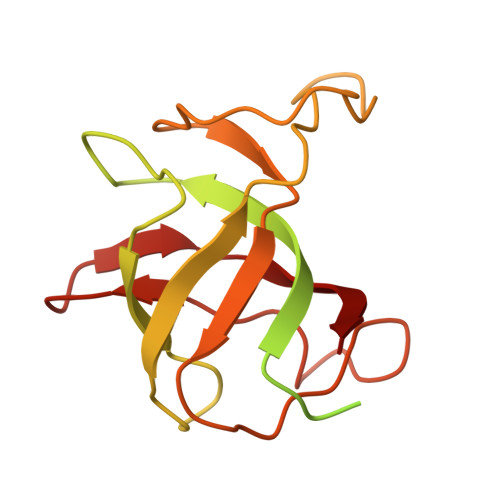
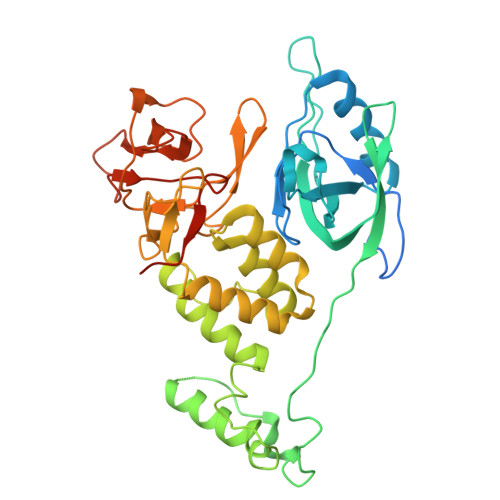
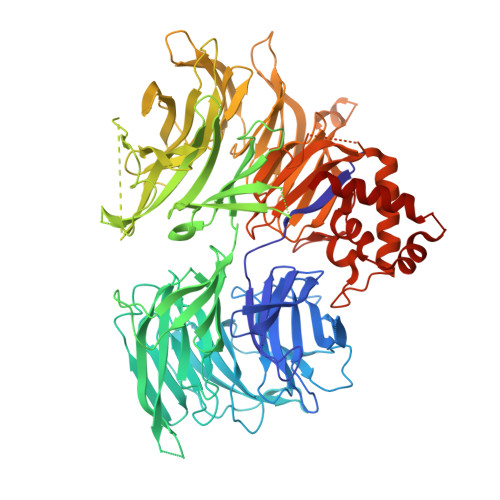
Cryo-EM structure of human DDB1-CRBN-GSPT1 in complex with GT19630


Experimental Data Snapshot

  • Method: ELECTRON MICROSCOPY
  • Resolution: 2.90 Å
  • Aggregation State: PARTICLE 
  • Reconstruction Method: SINGLE PARTICLE 

wwPDB Validation 3D Report Full Report

Validation slider image for 12BP

This is version 1.0 of the entry. See complete history

Literature

Dual MYC and GSPT1 Protein Degrader for MYC-Driven Hematologic Malignancies.

Nishida, Y.Impedovo, V.Ayoub, E.Baran, N.Scruggs, D.A.Mizuno, H.Khazaei, S.Ostermann, L.B.Kamachi, K.Zhang, L.Ishizawa, J.Singh, S.Bedoy, A.D.Mak, P.Y.Carter, B.Z.Sugihara, E.Takimoto, T.Tong, Y.Yan, H.Chen, D.Huang, J.Chu, H.F.Tong, L.Ahmed, Z.Namjoshi, S.Tainer, J.Gagea, M.Huynh, T.Maiti, A.Sasaki, K.Cuglievan, B.Boettcher, S.Haferlach, T.Tiziani, S.Ma, L.Andreeff, M.

(2026) Blood 

  • DOI: https://doi.org/10.1182/blood.2025030170
  • Primary Citation Related Structures: 
    12BP

  • PubMed Abstract: 

    Direct targeting of the oncoprotein MYC has not yet been successful. We here report a novel dual protein degrader, GT19630, which binds directly to MYC and G1 to S phase transition protein 1 (GSPT1). GT19630 disrupts a novel feedforward loop of MYC and GSPT1, where MYC promotes transcription of GSPT1, and GSPT1 senses the stop codon of MYC to properly terminate its translation. The agent induces integrated stress response and abrogates oxidative phosphorylation through inhibition of the TCA cycle, resulting in apoptosis. GT19630 has superior activity compared to GSPT1- targeting molecular glues. GT19630 induces profound anti-proliferative effects and apoptosis at low nanomolar concentrations in a multitude of leukemia and lymphoma cell lines and primary samples, including those with TP53 mutations. GT19630 is highly active in vivo in models of therapy-resistant hematologic malignancies, including Burkitt's lymphoma, acute myeloid leukemia (AML) and multiple myeloma. CD34+ AML blasts overexpress MYC protein compared to normal hematopoietic stem/progenitor cells (HSPCs) and GT19630 induces greater cytotoxicity in AML cells compared to normal HSPCs. Further, GT19630 restores sensitivity to venetoclax and profoundly prolongs survival in vivo in venetoclax-resistant AML. GT19630 was well tolerated in humanized Crbn mice. In conclusion, our data support the development of the MYC/GSPT1 degrader GT19630 as a therapeutic strategy of MYC-driven hematologic malignancies.


  • Organizational Affiliation
    • Section of Molecular Hematology and Therapy, Department of Leukemia, Houston, Texas, United States.

Macromolecule Content 

  • Total Structure Weight: 164.83 kDa 
  • Atom Count: 9,845 
  • Modeled Residue Count: 1,233 
  • Deposited Residue Count: 1,460 
  • Unique protein chains: 3

Macromolecules

Find similar proteins by:|  3D Structure
Entity ID: 1
MoleculeChains  Sequence LengthOrganismDetailsImage
Eukaryotic peptide chain release factor GTP-binding subunit ERF3AA [auth X]218Homo sapiensMutation(s): 0 
Gene Names: GSPT1ERF3A
EC: 3.6.5
UniProt & NIH Common Fund Data Resources
Find proteins for P15170 (Homo sapiens)
Explore P15170 
Go to UniProtKB:  P15170
PHAROS:  P15170
GTEx:  ENSG00000103342 
Entity Groups
Sequence Clusters30% Identity50% Identity70% Identity90% Identity95% Identity100% Identity
UniProt GroupP15170
Sequence Annotations
Expand
Reference Sequence
Find similar proteins by:|  3D Structure
Entity ID: 2
MoleculeChains  Sequence LengthOrganismDetailsImage
Protein cereblonB [auth Z]406Homo sapiensMutation(s): 0 
Gene Names: CRBNAD-006
UniProt & NIH Common Fund Data Resources
Find proteins for Q96SW2 (Homo sapiens)
Explore Q96SW2 
Go to UniProtKB:  Q96SW2
PHAROS:  Q96SW2
GTEx:  ENSG00000113851 
Entity Groups
Sequence Clusters30% Identity50% Identity70% Identity90% Identity95% Identity100% Identity
UniProt GroupQ96SW2
Sequence Annotations
Expand
Reference Sequence
Find similar proteins by:|  3D Structure
Entity ID: 3
MoleculeChains  Sequence LengthOrganismDetailsImage
DNA damage-binding protein 1C [auth Y]836Homo sapiensMutation(s): 0 
Gene Names: DDB1XAP1
UniProt & NIH Common Fund Data Resources
Find proteins for Q16531 (Homo sapiens)
Explore Q16531 
Go to UniProtKB:  Q16531
PHAROS:  Q16531
GTEx:  ENSG00000167986 
Entity Groups
Sequence Clusters30% Identity50% Identity70% Identity90% Identity95% Identity100% Identity
UniProt GroupQ16531
Sequence Annotations
Expand
Reference Sequence

Small Molecules

Ligands 2 Unique
IDChains Name / Formula / InChI Key2D Diagram3D Interactions
A1DBR(
Subject of Investigation/LOI)

Query on A1DBR


Download:Ideal Coordinates CCD File
D [auth Z]2-[(3S)-2,6-dioxopiperidin-3-yl]-1-oxo-N-[(4-{[2-(9H-pyrido[2,3-b]indol-9-yl)acetamido]methyl}phenyl)methyl]-2,3-dihydro-1H-isoindole-5-carboxamide
C35 H30 N6 O5
YGMJASQRQLEOKY-LJAQVGFWSA-N
ZN

Query on ZN


Download:Ideal Coordinates CCD File
E [auth Z]ZINC ION
Zn
PTFCDOFLOPIGGS-UHFFFAOYSA-N

Experimental Data & Validation

Experimental Data

  • Method: ELECTRON MICROSCOPY
  • Resolution: 2.90 Å
  • Aggregation State: PARTICLE 
  • Reconstruction Method: SINGLE PARTICLE 
EM Software:
TaskSoftware PackageVersion
RECONSTRUCTIONcryoSPARC
MODEL REFINEMENTPHENIX1.20.1_4487

Structure Validation

View Full Validation Report


Entry History 

& Funding Information

Deposition Data


Funding OrganizationLocationGrant Number
Other privateChina--

Revision History  (Full details and data files)

  • Version 1.0: 2026-08-26
    Type: Initial release