Download Mendeley
Structural basis for HIV-1 Rev recognition by the histone chaperone human Nap1.
Eren, E., Watts, N.R., Winkler, D.C., Wingfield, P.T.(2026) J Biol Chem 302: 113120-113120
- PubMed: 42103228 Search on PubMedSearch on PubMed Central
- DOI: https://doi.org/10.1016/j.jbc.2026.113120
- Primary Citation Related Structures:
11BC, 11BD, 11BE - PubMed Abstract:
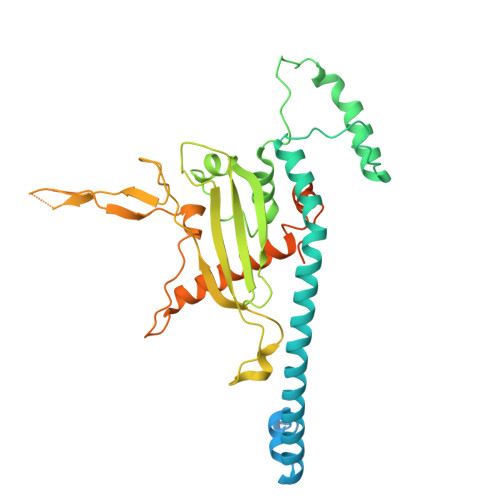
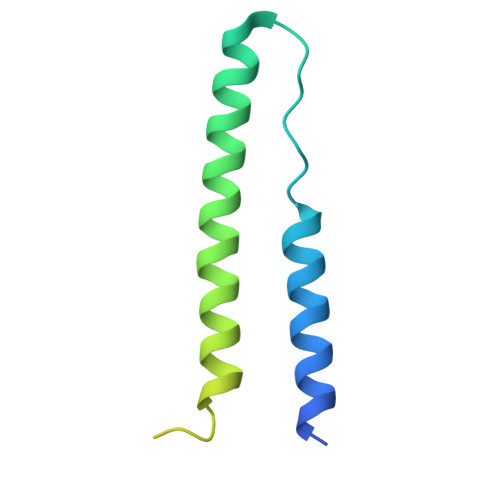
Human Nap1 (hNap1) is a histone chaperone involved in chromatin dynamics and has been shown to interact with the HIV-1 regulatory protein Rev, which is essential for nuclear export of viral RNA. Despite the functional significance of this interaction, its structural basis has remained elusive. Here, we present the X-ray crystal structure of hNap1 and the cryo-electron microscopy structure of the core domain of hNap1-Rev complex. The structure reveals that hNap1 binds Rev dimers via its acidic concave surface, engaging the Rev arginine-rich motif and oligomerization domain, and stabilizes Rev as a dimer-of-dimers tetramer. This interaction prevents higher-order Rev aggregation and enhances Rev's cooperative binding to the Rev Response Element. Surface plasmon resonance measurements confirm the formation of a stable complex with an apparent low-micromolar affinity between hNap1 and Rev, supporting a chaperone-like, reversible association. Our findings provide molecular insight into how hNap1 modulates Rev assembly and function, suggesting a model in which hNap1 primes Rev for productive engagement with viral RNA, thereby facilitating HIV-1 replication.
- Protein Expression Laboratory, National Institute of Arthritis and Musculoskeletal and Skin Diseases, National Institutes of Health, Bethesda, Maryland, USA. Electronic address: elif.eren@nih.gov.
Organizational Affiliation: