10UP | pdb_000010up

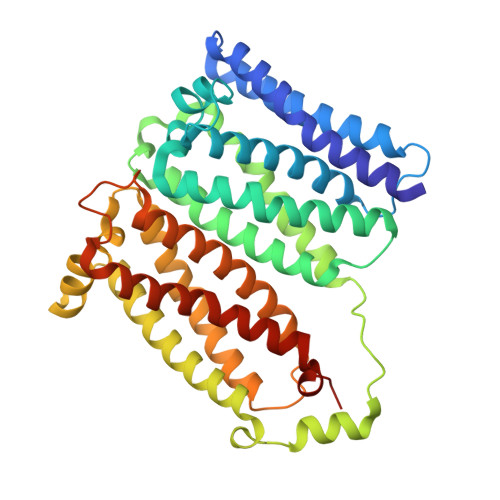
Structure of human TM6SF1

  • Classification: LIPID BINDING PROTEIN
  • Organism(s): Homo sapiens
  • Expression System: Homo sapiens
  • Mutation(s): No 

  • Deposited: 2026-02-09 Released: 2026-09-09 
  • Deposition Author(s): Hong, S., Li, X.
  • Funding Organization(s): National Institutes of Health/National Institute of Diabetes and Digestive and Kidney Disease (NIH/NIDDK)

Experimental Data Snapshot

  • Method: ELECTRON MICROSCOPY
  • Resolution: 2.86 Å
  • Aggregation State: PARTICLE 
  • Reconstruction Method: SINGLE PARTICLE 

wwPDB Validation 3D Report Full Report

Validation slider image for 10UP

This is version 1.1 of the entry. See complete history. 

Literature

Structure and function of TM6SF1 reveals role in mTORC1 signaling.

Hong, S., Jia, L., Wang, R., Elghobashi-Meinhardt, N., Hobbs, H.H., Li, X.

(2026) Proc Natl Acad Sci U S A 123: e2622424123-e2622424123

  • DOI: https://doi.org/10.1073/pnas.2622424123
  • Primary Citation Related Structures: 
    10UP, 11BR

  • PubMed Abstract: 

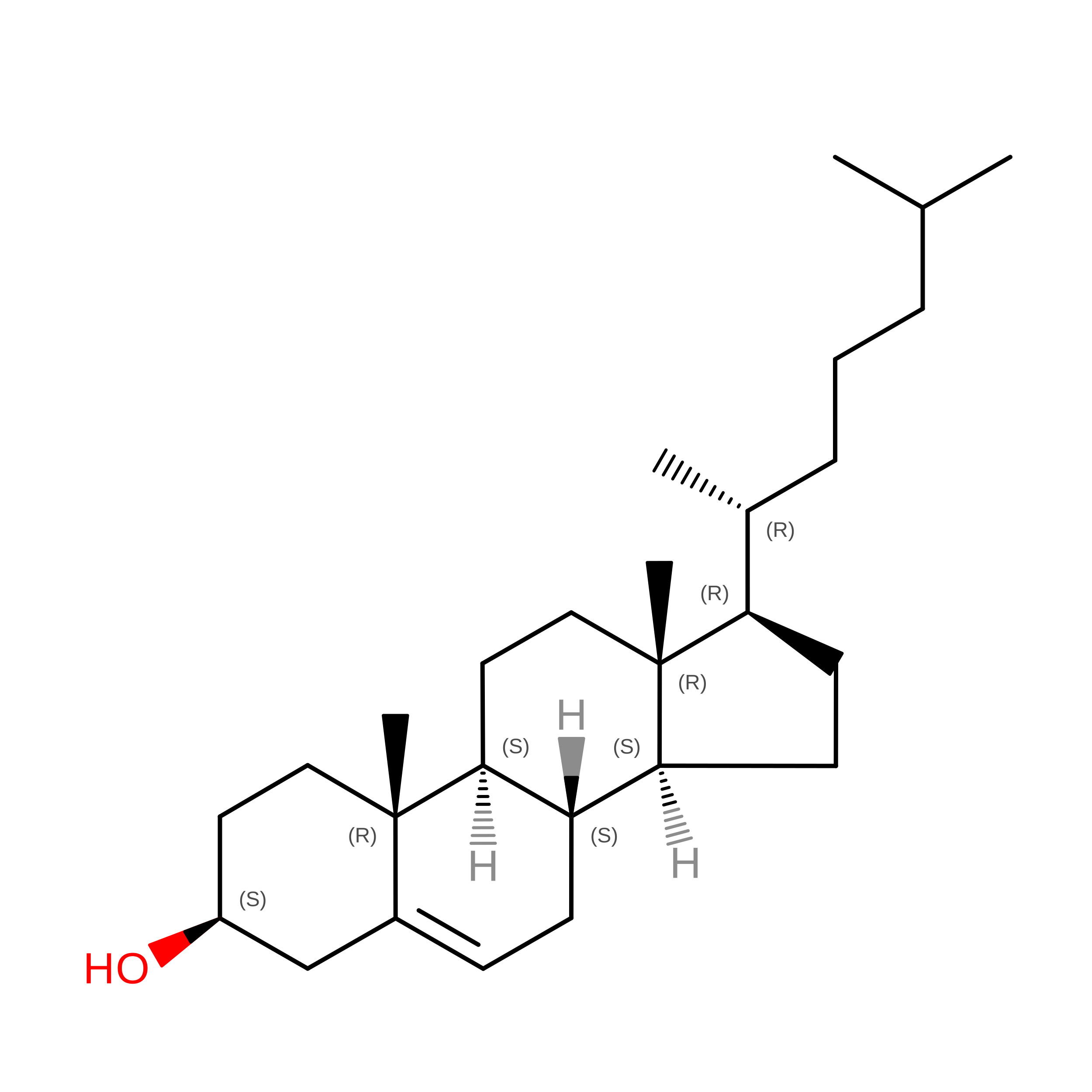
    The transmembrane 6 superfamily (TM6SF) comprises two members: TM6SF1, a ubiquitously expressed lysosomal membrane protein of unknown function, and TM6SF2, an endoplasmic reticulum protein required for bulk lipidation of Apolipoprotein B-containing lipoproteins. Here, we used cryo-electron microscopy (cryo-EM) to determine the structure of human TM6SF1 at 2.9-Å resolution. TM6SF1 forms a polytopic homodimer, with each protomer comprising 10 transmembrane helices (TMs). TMs 1-6 form a pocket that accommodates a cholesterol molecule. Cell-based assays revealed that loss of TM6SF1 perturbs mTORC1 signaling, resulting in reduced phosphorylation of S6 kinase 1 and 4E-BP1 and constitutive activation of transcription factor EB (TFEB), and that cholesterol is required for these effects. Biochemical analyses support the model that TM6SF1 directly engages LAMTOR1, a component of Ragulator complex, in a cholesterol-dependent manner. Together, these findings identify TM6SF1 as a lysosomal cholesterol binding protein involved in regulating mTORC1 signaling.


  • Organizational Affiliation: 
    • The Eugene McDermott Center for Human Growth and Development, University of Texas Southwestern Medical Center, Dallas, TX 75390.

Macromolecule Content 

  • Total Structure Weight: 84.11 kDa 
  • Atom Count: 5,824 
  • Modeled Residue Count: 726 
  • Deposited Residue Count: 740 
  • Unique protein chains: 1

Macromolecules

Find similar proteins by:|  3D Structure
Entity ID: 1
MoleculeChains  Sequence LengthOrganismDetailsImage
Transmembrane 6 superfamily member 1
A, B
370Homo sapiensMutation(s): 0 
Gene Names: TM6SF1
UniProt & NIH Common Fund Data Resources
Find proteins for Q9BZW5 (Homo sapiens)
Explore Q9BZW5 
Go to UniProtKB:  Q9BZW5
PHAROS:  Q9BZW5
GTEx:  ENSG00000136404 
Entity Groups
Sequence Clusters30% Identity50% Identity70% Identity90% Identity95% Identity100% Identity
UniProt GroupQ9BZW5
Sequence Annotations
Expand
Reference Sequence

Experimental Data & Validation

Experimental Data

  • Method: ELECTRON MICROSCOPY
  • Resolution: 2.86 Å
  • Aggregation State: PARTICLE 
  • Reconstruction Method: SINGLE PARTICLE 
EM Software:
TaskSoftware PackageVersion
MODEL REFINEMENTPHENIX1.21_5207
RECONSTRUCTIONcryoSPARC

Structure Validation

View Full Validation Report


Entry History 

& Funding Information

Deposition Data


Funding OrganizationLocationGrant Number
National Institutes of Health/National Institute of Diabetes and Digestive and Kidney Disease (NIH/NIDDK)United StatesNIH-DK090066

Revision History  (Full details and data files)

  • Version 1.0: 2026-09-09
    Type: Initial release
  • Version 1.1: 2026-09-23
    Changes: Data collection, Database references