Download Mendeley
Cleavage at the nsp5-nsp6 site of SARS-CoV-2 main protease intermediate precursor is faster from a monomer than a dimer form.
Aniana, A., Nashed, N.T., Ghirlando, R., Bhandari, D., Kovalevsky, A., Louis, J.M.(2026) J Biol Chem 302: 111395-111395
- PubMed: 41866037 Search on PubMedSearch on PubMed Central
- DOI: https://doi.org/10.1016/j.jbc.2026.111395
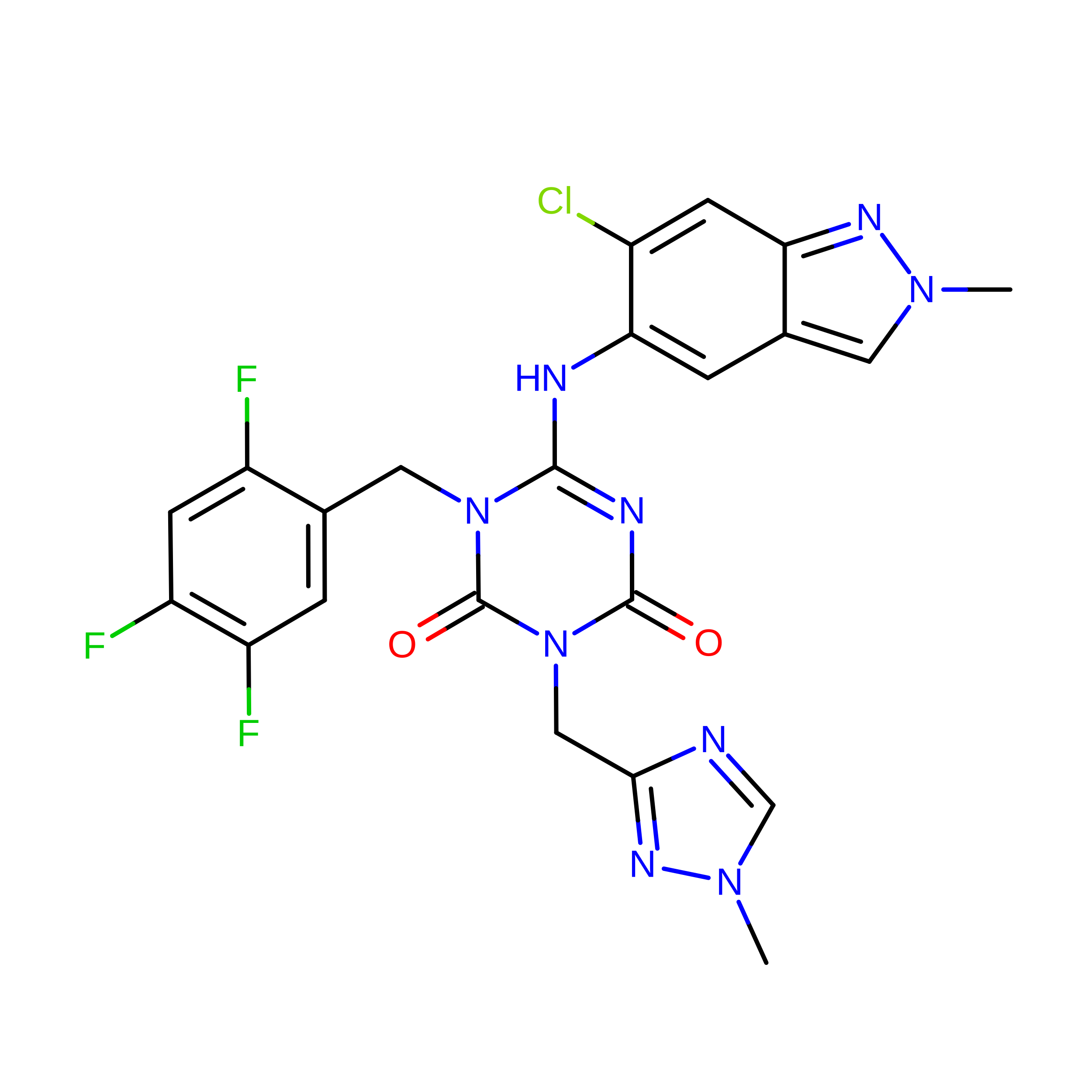
- Primary Citation Related Structures:
10DV - PubMed Abstract:
Our previous studies of severe acute respiratory syndrome coronavirus 2 main protease (MPro) precursor monomer indicate that the initial N-terminal nonstructural protein (nsp)4/nsp5 cleavage occurs intramolecularly, with a small fraction of the active site loop equilibrium being in the active state. To understand the influence of dimer formation of MPro upon N-terminal cleavage on the subsequent C-terminal nsp5/nsp6 intermolecular cleavage kinetics, the stepwise processing of a monomeric, inactive precursor containing the native terminal cleavage sites of MPro (MBP- (-6) MPro C145A(+3) -GB1-6H, 86.2 kDa) by mature WT MPro (MPro WT ) was investigated. Differential scanning fluorimetry and analytical ultracentrifugation measurements of various MPro constructs suggest that the C145A mutation decreases the dimer dissociation constant (K dimer ) by ∼26-fold, relative to WT C145 and H41A. The monomeric precursor's nsp4-nsp5 site appears to saturate MPro WT 's active sites and cleave faster, followed by a slower first-order cleavage at the C-terminal site. No detectable product resulting from the C-terminal cleavage is observed until most of the N-terminal cleavage is complete. The initial intermediate product (termed MPro C145A-IP ) is a homodimer with an estimated K dimer of <0.05 μM. In contrast, the first-order kinetics observed for the cleavage of the monomeric form of the intermediate product is at least 300 times faster than that of the dimer form. Room-temperature X-ray structure of the MPro C145A-IP -ensitrelvir complex is like that of the MPro WT -ensitrelvir complex and reveals a dynamic C-terminal region including MPro residues 302 to 306. These results are interpreted from the point of view of a mechanism in which nsp5-nsp6 cleavage may occur from a monomeric intermediate, and dimer formation restricts this cleavage.
- Laboratory of Chemical Physics, National Institute of Diabetes and Digestive and Kidney Diseases, National Institutes of Health, DHHS, Bethesda, Maryland, USA.
Organizational Affiliation: