Download Mendeley
Protein ligation for the assembly and study of nonribosomal peptide synthetase megaenzymes.
Pistofidis, A., Schmeing, T.M.(2025) RSC Chem Biol 6: 590-603
- PubMed: 39957992
- DOI: https://doi.org/10.1039/d4cb00306c
- Primary Citation of Related Structures:
9MEH - PubMed Abstract:
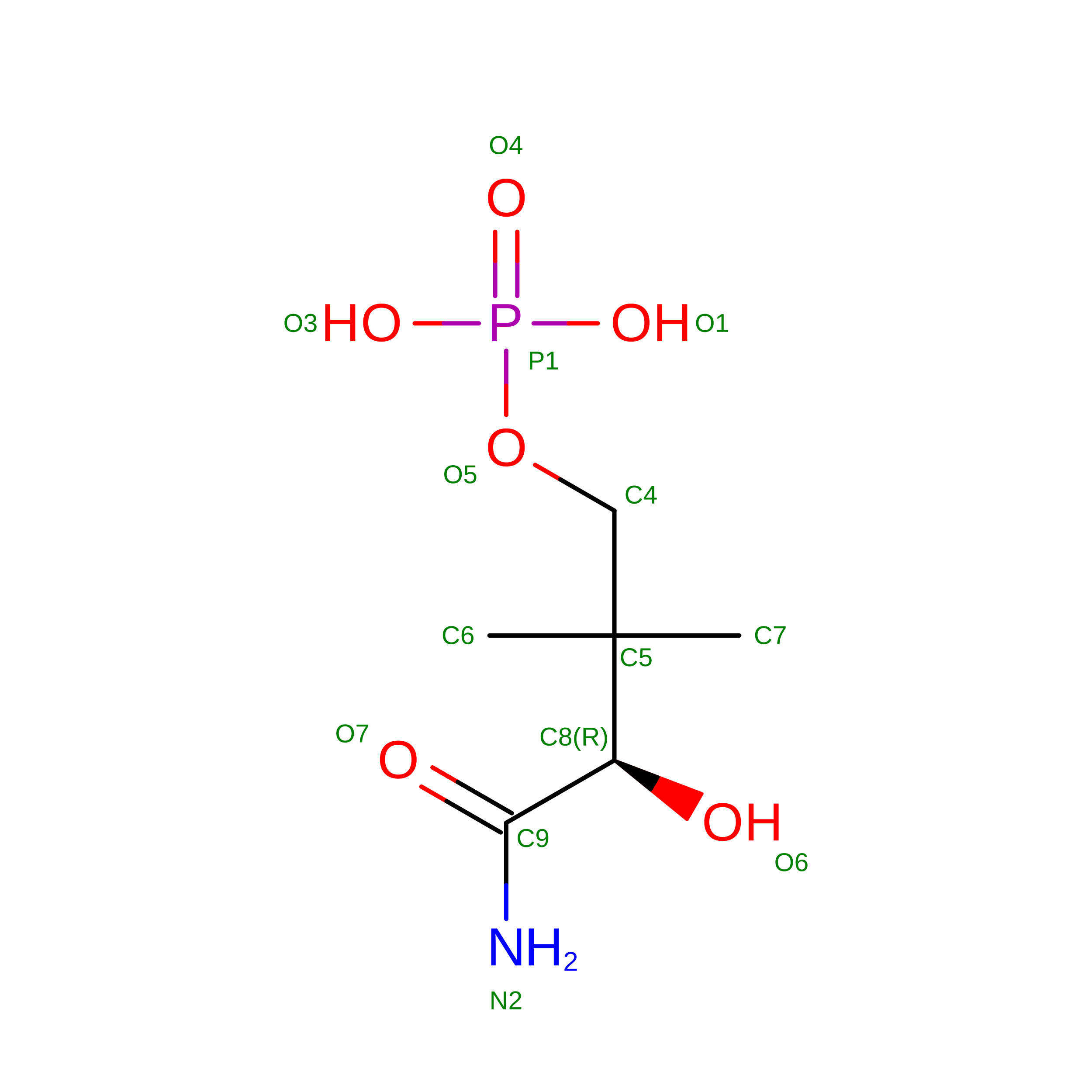
Nonribosomal peptide synthetases (NRPSs) are biosynthetic enzymes found in bacteria and fungi, that synthesize a plethora of pharmaceutically relevant compounds. NRPSs consist of repeating sets of functional domains called modules, and each module is responsible for the incorporation of a single amino acid to the growing peptidyl intermediate. The synthetic logic of an NRPS resembles an assembly line, with growing biosynthesis intermediates covalently attached to the prosthetic 4'-phosphopantetheine (ppant) moieties of T (thiolation or transfer) domains for shuttling within and between modules. Therefore, NRPSs must have each T domain phosphopantetheinylated to be functional, and host organisms encode ppant transferases that affix ppant to T domains. Ppant transferases can be promiscuous with respect to the T domain substrate and with respect to chemical modifications of the ppant thiol, which has been a useful characteristic for study of megaenzymes and other systems. However, defined studies of multimodular megaenzymes, where different analogs are required to be affixed to different T domains within the same multimodular protein, are hindered by this promiscuity. Study of NRPS peptide bond formation, for which two T domains simultaneously deliver substrates to the condensation domain, is a prime example where one would want two T domains bearing different acyl/peptidyl groups. Here, we report a strategy where two NRPS modules that are normally part of the same protein are expressed as separate constructs, modified separately with different acyl-ppants, and then ligated together by sortase A of Staphylococcus aureus or asparaginyl endopeptidase 1 of Oldenlandia affinis (OaAEP1). We assessed various reaction conditions to optimize the ligation reactions and maximize the yield of the complex of interest. Finally, we apply this method in large scale and show it allows the complex built by OaAEP1-mediated ligation to be characterized by X-ray crystallography.
- Department of Biochemistry and Centre de Recherche en Biologie Structurale, McGill University Montréal QC H3G 0B1 Canada martin.schmeing@mcgill.ca.
Organizational Affiliation: